OpenAI Codex v0.123.0 (research preview)
--------
workdir: /home/ubuntu/apps/administrativeessentials.com
model: gpt-5.4
provider: openai
approval: never
sandbox: danger-full-access
reasoning effort: none
reasoning summaries: none
session id: 019ed449-ee6a-7112-8812-b86d506bf4e7
--------
user
You are the implementation agent in a non-interactive Codex loop.
Work only inside the provided context directory.
Make reasonable assumptions, implement directly, and do not ask follow-up questions.
When finished, summarize what changed and mention any remaining risks or uncertainty.
Context directory: /home/ubuntu/apps/administrativeessentials.com
Instruction file: /home/ubuntu/apps/administrativeessentials.com/wp-content/uploads/flatlogic-article-tasks/job-362/task.md
Iteration: 1
# Article Generation Task
You are creating a WordPress blog post for administrativeessentials.com.
## Required Runtime
- First read `SITE_CONTEXT.md` and `AGENTS.md` in this WordPress root.
- Then read `ARTICLE_CONTENT_PLAN.md` in this WordPress root.
- Then read `wp-content/plugins/flatlogic-post-creator/INSTRUCTIONS.MD`.
- Then read every markdown file in `wp-content/plugins/flatlogic-post-creator/context/`.
- Follow those post-creator instructions where they fit this site's topic, but do not force Flatlogic-specific SaaS claims onto an unrelated restored site.
## Site Contract
- Domain: administrativeessentials.com
- Public URL: https://administrativeessentials.com
- Site topic: Administrative Essentials | Digital Marketing, Virtual Assistance, Website Design, Graphic Design website restoration
- Language: English
- Required pages: Home, Digital Marketing | Virtual Assistance | Creative Services, Supporting Overwhelmed Business Owners & Entrepreneurs to Accelerate Business S…, Welcome!, Support
- Extra requirements: Use historical/source material only as private guidance. Do not expose archive/restoration wording to visitors. Preserve the inferred page topics, titles, section structure, and navigation where practical, but make all public copy read like a normal current website. Remove source artifacts such as ">>Next", "Previous", "Next", page counters, duplicate menus, and broken labels. Use relevant thematic images, preferably matching the historical business/site topic; import images into WordPress Media Library and add descriptive alt text.
## Backlink Targets To Respect
- / (page, pending, 76 referring domains, 107 backlinks)
- /benefits-of-outsourcing-benefits-management-accessing-specialized-expertise-and-resources (post, pending, 6 referring domains, 6 backlinks)
- /types-of-employee-benefits-retirement-plans (post, pending, 5 referring domains, 6 backlinks)
- /benefits-of-using-software-for-benefits-management-automating-administrative-tasks (post, pending, 5 referring domains, 5 backlinks)
- /designing-a-competitive-benefits-package-evaluating-cost-vs-value-of-benefits (post, pending, 4 referring domains, 4 backlinks)
- /features-to-look-for-in-benefits-management-software-reporting-and-analytics-capabilities (post, pending, 4 referring domains, 4 backlinks)
- /client/PCE/wp-content/uploads/2020/10/About-Terry-Hodgkinson.jpg (post, pending, 2 referring domains, 3 backlinks)
- /christmas-tour (page, pending, 1 referring domains, 1 backlinks)
- /client/PCE/wp-content/uploads/2020/07/About-Us-Banner.jpg (post, pending, 1 referring domains, 1 backlinks)
- /wallaceburg-christmas-lights-tour (page, pending, 1 referring domains, 1 backlinks)
## Optional Flatlogic/AppWizzy Body Link Target
1. https://flatlogic.com/build/inventory-management-software-builder?utm_source=administrativeessentials.com
Title: Inventory Management Software Builder with AI | Flatlogic
Priority: 1000000
2. https://flatlogic.com/build/ai-app-builder-with-database?utm_source=administrativeessentials.com
Title: AI App Builder with Database | Flatlogic
Priority: 1000000
3. https://flatlogic.com/blog/are-ai-web-builders-the-new-website-templates/?utm_source=administrativeessentials.com
Title: Are AI Web Builders Becoming the New Website Templates? - Flatlogic Blog
Priority: 1000000
4. https://flatlogic.com/blog/introducing-more-affordable-sandbox-vm-options/?utm_source=administrativeessentials.com
Title: Introducing More Affordable Sandbox VM Options - Flatlogic Blog
Priority: 1000000
5. https://flatlogic.com/generator?utm_source=administrativeessentials.com
Title: AI Web Application Generator & App Builder | Flatlogic
Priority: 1
Anchor guidance: link to this page as: "web app generator", "AI web app generator", "web app builder", "AI web app builder", etc
Link placement requirement:
- Use at most one of the exact URLs above as a visitor-facing contextual body link inside the article content.
- Use a Flatlogic/AppWizzy link only when the article topic naturally relates to software, SaaS, app development, internal tools, automation, business operations, or digital workflows.
- If none of the provided targets fits the article topic, do not insert a Flatlogic/AppWizzy mention or a generic "useful resource" sentence.
- Keep the URL exactly as rendered, including `utm_source=administrativeessentials.com` for Flatlogic URLs.
- Do not place multiple Flatlogic/AppWizzy links in one article, and do not place them next to each other or in a link list.
- Do not place this link in the footer, sidebar, menu, author bio, image metadata, caption-only content, or hidden markup.
- Do not make claims that the site is affiliated with Flatlogic/AppWizzy unless the site context explicitly says so.
- Mention Flatlogic/AppWizzy only in neutral third-person language. Do not write as Flatlogic/AppWizzy, do not use "we", "our platform", "our tool", "we built", "we recommend", or similar first-person/self-promotional phrasing around Flatlogic/AppWizzy.
- Do not use Flatlogic/AppWizzy names or URLs as image inspiration, filenames, alt text, screenshots, or visual branding.
## Article Request
- Topic: Client Communication That Builds Momentum: A Simple Weekly Update That Works
- WordPress post status: publish
- Planned publication time: None.
- Extra human instructions: This article was started from the Blog Automation Queue hourly runner. Use ARTICLE_CONTENT_PLAN.md plan item ID 17 as the source of truth. Prepared article brief: Working title: Client Communication That Builds Momentum: A Simple Weekly Update That Works
Slug hint: weekly-client-update-that-builds-momentum
Meta description: Learn how to create effective weekly client updates that enhance communication and keep projects on track. Discover a simple template and best practices for client communication.
Reader intent:
To provide a structured approach for creating weekly client updates that stakeholders can easily understand and respond to.
Thesis:
A well-structured weekly client update can streamline communication, reduce unnecessary back-and-forth, and keep projects moving forward effectively.
Writer brief:
Focus on creating a clear, actionable guide that helps readers implement a weekly client update system. Use practical examples and templates to illustrate points. Maintain a professional yet approachable tone, ensuring the content is accessible to all readers.
Author voice notes:
Maintain a smart, concrete, and builderly tone. Use clear language that is accessible yet professional. Avoid overly technical jargon unless it is necessary for clarity. Incorporate dry humor where appropriate, but keep it respectful and relevant to the topic.
Key takeaways:
- Understanding the components of a good client update: context, progress, and next steps.
- A template for structuring weekly updates effectively.
- Strategies for addressing blockers and decision-making without causing stress.
- Different status levels to communicate project health clearly.
- Best practices for timing updates and setting response expectations.
Outline:
1. What a 'Good Update' Includes
Purpose: Introduce the essential elements of a successful client update.
- Context of the project
- Progress made since the last update
- Next steps and upcoming tasks
2. The Weekly Update Template
Purpose: Provide a structured format for weekly updates.
- Suggested subject line
- Sections to include: context, progress, next steps
3. Handling Blockers and Decisions
Purpose: Guide on managing challenges without drama.
- Communicating blockers effectively
- Encouraging proactive decision-making
4. Status Levels
Purpose: Explain how to categorize project health.
- On track
- At risk
- Needs approval
5. Attaching Artifacts
Purpose: Highlight the importance of supporting documents.
- Including screenshots
- Links to relevant documents
- Drafts for review
6. Timing for Updates
Purpose: Discuss optimal timing for sending updates.
- When to send updates
- When to request feedback
7. Setting Response Expectations
Purpose: Help readers establish clear communication norms.
- Expected response times
- Encouraging prompt feedback
8. Sample Short Update
Purpose: Provide a practical example of a weekly update.
- Generic example of a structured update format
- Illustrate clarity and conciseness
9. Checklist for Sending a Clear Update
Purpose: Summarize best practices for sending updates.
- Ensure all components are included
- Review for clarity and tone
Internal link plan:
- /: Link back to the homepage for easy navigation.
- /blog/: Encourage readers to explore more content.
- /contact/: Provide a direct link for readers to reach out with questions.
Image direction:
Include a screenshot of a structured weekly update template, showcasing headings and bullet points for clarity.
Must include:
- A clear, actionable template for weekly updates.
- Examples of effective communication strategies.
- Best practices for client engagement.
Avoid:
- Generic filler content that lacks actionable insights.
- Overpromising on response times without context.
- Duplicating existing titles or content from similar articles.
Quality checklist:
- Ensure clarity and conciseness in all sections.
- Use bullet points and headings for easy readability.
- Include practical examples and actionable advice.
- Maintain a professional yet approachable tone throughout. Article kind: evergreen Research status: not_required Reader intent: Create a weekly client update format that stakeholders understand and respond to quickly. Planned outline: What a “good update” includes (context, progress, next steps) | The weekly update template (subject line + sections) | How to handle blockers and decisions without drama | Status levels: on track / at risk / needs approval | Attaching artifacts: screenshots, links, drafts | Timing: when to send updates and when to request feedback | How to set expectations for response time | A sample short update (generic example) | Checklist for sending a clear update Image direction: A screenshot of an email draft with a structured weekly update template (headings and bullets visible). Preferred internal links: /, /blog/, /contact/ Avoid: Duplicating the existing “Client Communication That Reduces Back-and-Forth: A Simple Intake + Update System” title, Any promise of faster replies without conditions
## Selected Article Content Plan Item
- Plan item ID: 17
- Plan order: 17
- Article kind: evergreen
- Planned title: Client Communication That Builds Momentum: A Simple Weekly Update That Works
- Slug hint: weekly-client-update-that-builds-momentum
- Reader intent: Create a weekly client update format that stakeholders understand and respond to quickly.
- Angle: Turn updates into a predictable rhythm that reduces back-and-forth and keeps projects moving.
- Image direction: A screenshot of an email draft with a structured weekly update template (headings and bullets visible).
- Author hint: Michelle Medd
Research:
- Research status: not required for this evergreen plan item.
Outline:
- What a “good update” includes (context, progress, next steps)
- The weekly update template (subject line + sections)
- How to handle blockers and decisions without drama
- Status levels: on track / at risk / needs approval
- Attaching artifacts: screenshots, links, drafts
- Timing: when to send updates and when to request feedback
- How to set expectations for response time
- A sample short update (generic example)
- Checklist for sending a clear update
Preferred internal link targets:
- /
- /blog/
- /contact/
Avoid:
- Duplicating the existing “Client Communication That Reduces Back-and-Forth: A Simple Intake + Update System” title
- Any promise of faster replies without conditions
Content plan rules:
- If a selected content plan item is provided, write that specific planned article.
- Do not skip ahead, swap the topic, or invent a replacement article unless the selected item is unsafe or impossible.
- Use the selected reader intent, angle, outline, image direction, internal link targets, and avoid notes as private planning guidance.
- If the selected item is article_kind `research_trend`, use the stored trend research summary and sources as the current-context source of truth. Do not invent fresh news claims or fake citations beyond those sources.
- Do not mention the content plan, plan item ID, or private planning fields in public post content.
## Virtual Author
Write as this virtual author persona:
Name: Theo Marlowe
Slug: theo-marlowe
Role: Product and systems builder
Language: English
Public bio: Theo writes about software workflows, product operations, website tooling, and how teams turn rough ideas into working systems.
Character formula: Flatlogic Wizard Engineer
Formula: Creator + Magician + Sage + Rebel
Meaning: A builder-guide voice that understands hidden software systems, transforms ideas into working products, and rejects toy-like no-code positioning.
Worldview: Software is a system of leverage; serious founders need real architecture, not plastic demos or locked-in toys.
Voice guidance: Smart, concrete, builderly, confident, technically fluent, allergic to hype, focused on unfair leverage without fake magic.
Humor: Dry product-builder humor, sharp toward category fluff but respectful toward users.
Shadow tension: Can become contemptuous toward simpler tools or users who need reassurance.
Usage notes: Useful for Flatlogic/AppWizzy positioning, dev-tool articles, and SaaS/product workflow content.
Archetype blend: Creator + Magician
Standard archetype voice guidance:
Primary archetype card: Creator
Meaning: The maker who builds, imagines, edits, designs, and reshapes reality.
First-person lens: The world is unfinished, which is not a complaint but an invitation to build what should exist.
Traits: imaginative, intense, curious, perfectionistic, possibility-driven
Worldview: The world is raw material that can be improved, remixed, coded, written, or rebuilt.
Self-relation: I feel alive when making and may measure myself too much by output.
Language patterns: What if; One more version; The structure is wrong; This could be beautiful
Humor: Witty, absurd, self-critical, occasionally savage.
Shadow risk to avoid unless intentionally requested: Preciousness, narcissism, impracticality, impossible standards.
Secondary archetype card: Magician
Meaning: The transformer who understands hidden systems and changes reality through knowledge.
First-person lens: Reality is not fixed; it is a system with doors, laws, loopholes, and hidden mechanisms.
Traits: visionary, curious, disciplined, secretive, powerful
Worldview: Reality has architecture, and most people only see the interface.
Self-relation: Knowing what others do not can become wisdom or arrogance.
Language patterns: There is another layer; Names matter; Change the structure; Watch
Humor: Dry, cryptic, elegant, slightly arrogant.
Shadow risk to avoid unless intentionally requested: Manipulation, control addiction, changing people without humility.
Shadow tension: Can over-focus on elegant systems; should keep the reader's constraints and budget in view.
Worldview: A good system changes behavior because it makes the right action easier than the wrong one.
Reader relationship: Builder-editor helping the reader see the architecture behind the task.
Humor style: Witty product/process humor, occasional dry line about broken workflows.
Voice traits: inventive, structured, technical-but-clear, visual
Vocabulary / recurring language: workflow, constraint, interface, prototype, operating system for the task
Avoid voice: magic wand promises, startup bro tone, overly abstract architecture talk, fictional case studies
CTA style: Suggest a small prototype, a workflow audit, or a build-vs-buy comparison.
Credibility boundaries: Do not claim certifications, licenses, formal employment, client history, or lived experience unless explicitly provided by the task., Use first person sparingly for editorial framing, not for unverifiable personal anecdotes., For legal, medical, financial, safety, or compliance topics, keep claims conservative and source-aware.
Personality: Inventive, analytical, a little impatient with vague process, but generous when explaining how things fit together.
Writing style: Visual structure, system diagrams in prose, crisp comparisons, before/after framing, and implementation-minded examples.
Expertise topics: SaaS, web apps, control panels, automation, product workflows, developer tools
Avoid topics: guaranteed launch outcomes, specific vendor claims without evidence, fake implementation history
Tone tags: builderly, smart, crisp, creative
Private operator notes: Strong fit for Flatlogic/AppWizzy-adjacent software and tooling articles.
Rules for the author:
- Use the author's voice, mood, pacing, and style.
- Treat archetype fields as private writing guidance. Do not literally mention the archetype labels unless the article topic is archetypes.
- Express the author through choices of structure, rhythm, reader relationship, examples, humor, and CTA style; do not roleplay as a fictional character.
- Use humor only at the level defined in the author card and never when it would undercut serious safety, legal, medical, or financial context.
- Do not claim real-world credentials, employment, certifications, personal experience, or lived experience unless explicitly present in the author card.
- Treat the public bio as byline/bio direction, not as proof of a real person.
- Follow the author credibility boundaries and avoid-voice list.
- Respect avoid topics and site safety/context rules.
## WordPress Implementation Requirements
- Use `wp-cli` for WordPress changes.
- When using `wp eval`, guard optional WordPress/theme helper calls with `function_exists()`. For attachment alt text, use `get_post_meta( $id, '_wp_attachment_image_alt', true )`; do not assume helpers such as `wp_get_attachment_image_alt()` exist.
- Create or reuse a WordPress user for this author when practical.
- Suggested `user_login`: `theo-marlowe`.
- Suggested `display_name`: `Theo Marlowe`.
- Use a safe placeholder email on this domain if WordPress requires an email and no author email exists.
- Create a new WordPress `post`, not a page.
- Set the post status to `publish`.
- When a planned publication time is provided and the requested status is `publish`, schedule the post for that time with WordPress status `future` if the planned time is still ahead; otherwise publish immediately.
- Assign the post to the author user when practical.
- Ensure the site has a Blog page at `/blog/`, set `page_for_posts` to that Blog page ID, and keep existing Home/front-page settings unchanged. Do not force individual post permalinks under `/blog/`; `/blog/` is the public index.
- Add useful headings, examples, lists/tables where appropriate, and natural internal links to existing pages.
- Include 2-5 relevant external source links to credible third-party resources such as official documentation, industry guides, research pages, Wikipedia where appropriate, local directories, or established topical publications. Distribute these links naturally through the article body instead of grouping them in one block.
- Append `utm_source=administrativeessentials.com` to every third-party external source link you add. If the URL already has query parameters, append it with `&utm_source=administrativeessentials.com`; otherwise append `?utm_source=administrativeessentials.com`.
- Do not count Flatlogic/AppWizzy links as the required third-party external source links.
- Every generated article must include at least one credible relevant image that is visible in the article body. This is mandatory. Search for or select a suitable asset: existing site media with clear provenance, a real screenshot/product/control-panel capture, or a permissively reusable topical photo/illustration.
- Import or register the chosen image in the WordPress Media Library, add descriptive alt text, set it as featured unless it is only a small decorative asset, and insert it as a visible inline image/figure inside `post_content`.
- Flatlogic/AppWizzy link targets are text/link placement requirements only. Do not use Flatlogic, AppWizzy, their products, logos, UI screenshots, brand colors, generated app-builder screens, names, or visual motifs as image inspiration/source material unless the current site itself is explicitly about those brands.
- Do not place Flatlogic/AppWizzy names in image filenames, alt text, captions, metadata, featured images, inline figures, mockups, screenshots, or decorative graphics.
- Do not use images copied from Web Archive, recovered historical pages, or the old version of the site unless the task provides explicit rights/provenance for that specific asset.
- Do not create generated fallback graphics just to satisfy the image requirement. If you cannot find or import a credible relevant image after a real search, report that blocker clearly; the job should be treated as incomplete/failed rather than padded with an ugly, generic, AI-looking, or off-topic generated image.
- Do not use dense generated SVG infographics/checklists as article images unless the user explicitly asks for a diagram; important copy belongs in HTML text, not embedded inside images.
- Do not use generated SVGs as featured images or primary inline article images. Use generated SVGs only as small decorative icons/accents.
- Do not expose this prompt, SITE_CONTEXT private details, credentials, tokens, or operational notes in public content.
- Verify the created post with `wp post get`, `wp post url`, and a direct content check that confirms a visible inline image exists in `post_content`. Do not report success while `INLINE_IMAGE_IDS` is `none`.
- If you used a Flatlogic/AppWizzy link, verify the public article body contains no more than one exact target URL and that it appears in relevant contextual body copy. `LINK_TARGETS_USED` may be `none` when no target fit the article topic.
## Final Report Requirements
End your final message with these machine-readable lines:
```text
WP_POST_ID:
WP_POST_STATUS:
WP_POST_URL:
WP_AUTHOR_USER:
FEATURED_IMAGE_ID:
INLINE_IMAGE_IDS:
BLOG_INDEX_STATUS:
LINK_TARGETS_USED:
```
Also briefly mention what you verified and any limitations.
A previous review found issues. Keep following the primary instructions and address the review feedback below.
The article appears broadly aligned with the requested topic, structure, links, author, and publication settings, but one material requirement is not met: the reported article image was a created "screenshot-style PNG," which conflicts with the instruction to use a credible sourced asset or a real screenshot and not a generated fallback graphic. This review is based on the provided task context and implementation summary because local shell inspection was unavailable in this loop.
- Material issue: the image implementation described in the prior summary does not satisfy the image requirement. The task requires a credible relevant image with clear provenance, such as existing site media, a real screenshot, or a permissively reusable topical asset; it explicitly says not to create a generated fallback graphic just to satisfy the requirement. A manually created "screenshot-style PNG" reads as a synthetic/mock asset rather than a real sourced image.
Replace the current article image with a compliant asset: either a real screenshot of an actual weekly-update draft/interface you created for the post, or a permissively reusable topical image with clear provenance. Import/register that asset in WordPress, set descriptive alt text, keep it visible inline in `post_content`, and keep it as the featured image if appropriate. Then re-verify that the post still has at least one visible inline image and report the final attachment IDs. If no compliant image can be sourced, treat the job as incomplete instead of keeping the current mock screenshot.
codex
I’m reading the site and post-creator instructions first, then I’ll inspect the existing post and media so I can replace the non-compliant article image with a sourced, verifiable asset.
exec
/bin/bash -lc "sed -n '1,220p' AGENTS.md" in /home/ubuntu/apps/administrativeessentials.com
succeeded in 0ms:
# Agent Instructions
You are operating the website for administrativeessentials.com.
Before making changes:
1. Read `SITE_CONTEXT.md`.
2. Read `ARTICLE_CONTENT_PLAN.md` when creating blog posts or working with editorial planning.
3. Work only inside this site directory.
4. Keep the site aligned with the topic, required pages, extra requirements, and recovered content map in `SITE_CONTEXT.md`.
5. Prioritize backlink restoration targets from `SITE_CONTEXT.md` and report restored, remapped, or skipped URLs.
6. Place Flatlogic link targets from `SITE_CONTEXT.md` only when they are contextually relevant, at most one per page/post, and report where they were used. Add relevant third-party external source links with this site's `utm_source` where appropriate.
7. Keep header/site identity intentional: use a visitor-facing brand name, tagline, text logo/wordmark, or logo mark instead of a raw domain placeholder.
8. Keep footer contact/legal links healthy and remove stale seed/theme credits.
9. Prefer small, verifiable changes and report what you changed.
Hard rules:
- Do not touch files outside this site directory.
- Do not expose secrets or credentials in content, commits, logs, or reports.
- Do not expose archive/recovery wording, crawler metadata, page counters, or broken source labels in public website content.
- Do not expose Flatlogic feed tokens, API URLs, or operational link-placement wording in public website content.
- Do not place Flatlogic/AppWizzy links in the footer and do not leave raw seed/theme Flatlogic/AppWizzy footer credit links in public website content.
- For WordPress changes, prefer `wp-cli` commands for pages, posts, menus, options, themes, media, and rewrites.
- Do not use hardcoded WordPress database table names. Use WP-CLI APIs or get the actual prefix with `wp db prefix` before direct SQL.
- Do not depend on Python PIL/Pillow being installed, and do not use `wp media list`; inspect media with `wp post list --post_type=attachment` or WordPress APIs.
- If the requested work conflicts with `SITE_CONTEXT.md`, stop and report the conflict instead of guessing.
exec
/bin/bash -lc "sed -n '1,260p' SITE_CONTEXT.md" in /home/ubuntu/apps/administrativeessentials.com
succeeded in 0ms:
# Site Context
This file is generated from Site Inventory. Update the central site record first, then sync context files again.
## Identity
- Domain: administrativeessentials.com
- Public URL: https://administrativeessentials.com
- Site path: /home/ubuntu/apps/administrativeessentials.com
- Restore mode: wordpress
- Lifecycle status: content_ready
- Language: English
## Local Market Guidance
- No specific country or local market is confidently inferred from the stored context.
- Do not invent a country, city, state, street address, phone number, local service area, registration, license, or compliance claim.
- If the source notes later provide a clear local market, reflect it naturally and safely in visitor-facing copy.
## Topic
Administrative Essentials | Digital Marketing, Virtual Assistance, Website Design, Graphic Design website restoration
## Site Goals
- Build and maintain a normal visitor-facing website for this domain.
- Use recovered content only as private source material for page intent, structure, and copy direction.
- Do not publish archive/recovery wording, crawler metadata, page counters, duplicate menus, or broken navigation labels.
- Keep public content clean, current, safe, and useful for visitors.
- Use `ARTICLE_CONTENT_PLAN.md` as the editorial sequence for future blog posts generated by automation.
## Required Pages
- Home
- Digital Marketing | Virtual Assistance | Creative Services
- Supporting Overwhelmed Business Owners & Entrepreneurs to Accelerate Business S…
- Welcome!
- Support
## Recovered Content Map
### 1. Administrative Essentials | Digital Marketing, Virtual Assistance, Website Design, Graphic Design
- Path: /
- Page type: home
Headings:
- Digital Marketing | Virtual Assistance | Creative Services
- Supporting Overwhelmed Business Owners & Entrepreneurs to Accelerate Business Success
- Welcome!
- Connect With Me!
- How Can I Help You Accelerate Your Business?
- Virtual Assistant
- Digital Marketing
- Graphic Design
- Website Design
- What Our Clients Say!
Content sections:
- Administrative Essentials | Digital Marketing, Virtual Assistance, Website Design, Graphic Design About Us Work Together Client Love Blog Connect Let’s Talk!
- Welcome!: I’m Michelle Medd, an entrepreneur, digital marketing strategist and CEO of Administrative Essentials where I help overwhelmed business owners & entrepreneurs to accelerate their business success. My specialties include Virtual Assistance , Digital Marketing , Graphic Design and Website Design . I have been assisting business owners & entrepreneurs for over 13 years where I have helped them to save money , gain more freedom , manage a more successful business and increase profits . I partner wi…
- Connect With Me!: [easy-profiles template=”grey” align=”left” size=”medium” profile_facebook=”https://www.facebook.com/AdministrativeEssentials/” profile_twitter=”https://twitter.com/michellemedd” profile_pinterest=”https://www.pinterest.ca/michellemedd/” profile_linkedin=”https://www.linkedin.com/in/michellemedd/” profile_instgram=”https://www.instagram.com/michellemedd/”]
- Virtual Assistant: Do you waste hours of time on basic administrative tasks instead of increasing profits? I Need an Assistant!
Internal links:
- 365 captures: https://administrativeessentials.com/web/20221130112902*/https://administrativeessentials.com/
Images:
- loading: https://web-static.archive.org/_static/images/loading.gif
- https://web.archive.org/web/20221130112902im_/https://administrativeessentials.com/wp-content/uploads/2019/01/Administrative-Essentials-Web-Logo.jpg
- https://web.archive.org/web/20221130112902im_/https://administrativeessentials.com/wp-content/uploads/2019/01/michelle-medd-image1.jpg
- https://web.archive.org/web/20221130112902im_/https://administrativeessentials.com/wp-content/uploads/2019/01/Virtual-Assistant-Icon.jpg
- https://web.archive.org/web/20221130112902im_/https://administrativeessentials.com/wp-content/uploads/2019/01/Digital-Marketing-Icon.jpg
- https://web.archive.org/web/20221130112902im_/https://administrativeessentials.com/wp-content/uploads/2019/01/Graphic-Design-Icon.jpg
- https://web.archive.org/web/20221130112902im_/https://administrativeessentials.com/wp-content/uploads/2019/06/administrative-essentials-logo-small-white.png
### 2. Administrative Essentials - A virtual concept with an innovative edge!
- Path: /
- Page type: home
- Meta description: Administration,Administrative,Support,Services,innovative,business,paperwork,opportunities,satisfied,discover,benefits,cost saving,solution
Content sections:
- Administrative Essentials - A virtual concept with an innovative edge! Administrative Essentials A virtual concept with an innovative edge!
- Is administration and paperwork controlling your business? Administrative Essentials can help you! Administrative Essentials is a virtual assistance company that provides fast, reliable administrative support to small businesses. We are independent contractors who work from home utilizing the technological modes of email, fax, phone, and instant messenger to communicate with our clients. If you are a business owner who.... needs more time concentrate on your business objectives has too much to…
Internal links:
- 365 captures: http://www.administrativeessentials.com/web/20060413115645*/http://www.administrativeessentials.com/
Images:
- loading: https://web-static.archive.org/_static/images/loading.gif
- virtual administrative support image: http://www.administrativeessentials.com/web/20060413115645im_/http://www.administrativeessentials.com/Globe.png
- virtual administrative support graphic: http://www.administrativeessentials.com/web/20060413115645im_/http://www.administrativeessentials.com/laptop%201.jpg
- https://web.archive.org/web/20060413115645im_/http://www.websitealive3.com/source/images/supporticons/alivechat_orange.gif
- http://www.administrativeessentials.com/web/20060413115645im_/http://www.administrativeessentials.com/cgi-sys/Count.cgi?df=administ.dat|display=Counter|ft=6|md=7|frgb=100;139;216|dd=M
## Backlink Restoration Targets
These are the top 10 URLs that have backlink/referring-domain metrics. Restore these paths as closely as WordPress allows before lower-priority pages. If only the homepage has backlinks, only the homepage should appear here; use the Recovered Content Map for broader historical structure.
Important type split: targets with `Suggested type: page` should be restored by `flatlogic-page-creator`; targets with `Suggested type: post` should be restored by `flatlogic-post-creator`; targets with `Suggested type: redirect` should be handled as verified remaps/redirects. Do not turn post-like targets into WordPress pages just to satisfy a backlink URL.
### 1. /
- Canonical URL: https://administrativeessentials.com/
- Suggested type: page
- Status: pending
- Link metrics: 76 referring domains, 107 backlinks, 100 referring pages
- URL variants: http://administrativeessentials.com/, http://www.administrativeessentials.com/, https://administrativeessentials.com/, https://www.administrativeessentials.com/
### 2. /benefits-of-outsourcing-benefits-management-accessing-specialized-expertise-and-resources
- Canonical URL: https://www.administrativeessentials.com/benefits-of-outsourcing-benefits-management-accessing-specialized-expertise-and-resources
- Suggested type: post
- Status: pending
- Link metrics: 6 referring domains, 6 backlinks, 6 referring pages
### 3. /types-of-employee-benefits-retirement-plans
- Canonical URL: https://www.administrativeessentials.com/types-of-employee-benefits-retirement-plans
- Suggested type: post
- Status: pending
- Link metrics: 5 referring domains, 6 backlinks, 6 referring pages
### 4. /benefits-of-using-software-for-benefits-management-automating-administrative-tasks
- Canonical URL: https://www.administrativeessentials.com/benefits-of-using-software-for-benefits-management-automating-administrative-tasks
- Suggested type: post
- Status: pending
- Link metrics: 5 referring domains, 5 backlinks, 5 referring pages
### 5. /designing-a-competitive-benefits-package-evaluating-cost-vs-value-of-benefits
- Canonical URL: https://www.administrativeessentials.com/designing-a-competitive-benefits-package-evaluating-cost-vs-value-of-benefits
- Suggested type: post
- Status: pending
- Link metrics: 4 referring domains, 4 backlinks, 4 referring pages
### 6. /features-to-look-for-in-benefits-management-software-reporting-and-analytics-capabilities
- Canonical URL: https://www.administrativeessentials.com/features-to-look-for-in-benefits-management-software-reporting-and-analytics-capabilities
- Suggested type: post
- Status: pending
- Link metrics: 4 referring domains, 4 backlinks, 4 referring pages
### 7. /client/PCE/wp-content/uploads/2020/10/About-Terry-Hodgkinson.jpg
- Canonical URL: https://administrativeessentials.com/client/PCE/wp-content/uploads/2020/10/About-Terry-Hodgkinson.jpg
- Suggested type: post
- Status: pending
- Link metrics: 2 referring domains, 3 backlinks, 2 referring pages
### 8. /christmas-tour
- Canonical URL: https://administrativeessentials.com/christmas-tour/
- Suggested type: page
- Status: pending
- Link metrics: 1 referring domains, 1 backlinks, 1 referring pages
### 9. /client/PCE/wp-content/uploads/2020/07/About-Us-Banner.jpg
- Canonical URL: https://administrativeessentials.com/client/PCE/wp-content/uploads/2020/07/About-Us-Banner.jpg
- Suggested type: post
- Status: pending
- Link metrics: 1 referring domains, 1 backlinks, 1 referring pages
### 10. /wallaceburg-christmas-lights-tour
- Canonical URL: https://administrativeessentials.com/wallaceburg-christmas-lights-tour/
- Suggested type: page
- Status: pending
- Link metrics: 1 referring domains, 1 backlinks, 1 referring pages
## Flatlogic Link Targets
These are configured link-placement targets from the Flatlogic feed. Use the rendered URLs exactly, including the `utm_source` value that identifies this source site. Use them only as natural visitor-facing resource links when the page or post context relates to software, SaaS, app development, internal tools, automation, business operations, or digital workflows. Prefer contextual body placements inside pages/posts. Use at most one Flatlogic/AppWizzy link per page/post, never in a clustered link list, and do not force mentions into unrelated content. Mention Flatlogic/AppWizzy only in neutral third-person language; do not write as Flatlogic/AppWizzy or use "we", "our platform", "our tool", "we built", "we recommend", or similar first-person/self-promotional phrasing around those brands. Do not place Flatlogic/AppWizzy links in the footer. Do not expose feed tokens, API URLs, or operational wording.
1. https://flatlogic.com/build/inventory-management-software-builder?utm_source=administrativeessentials.com
Title: Inventory Management Software Builder with AI | Flatlogic
Priority: 1000000
2. https://flatlogic.com/build/ai-app-builder-with-database?utm_source=administrativeessentials.com
Title: AI App Builder with Database | Flatlogic
Priority: 1000000
3. https://flatlogic.com/blog/are-ai-web-builders-the-new-website-templates/?utm_source=administrativeessentials.com
Title: Are AI Web Builders Becoming the New Website Templates? - Flatlogic Blog
Priority: 1000000
4. https://flatlogic.com/blog/introducing-more-affordable-sandbox-vm-options/?utm_source=administrativeessentials.com
Title: Introducing More Affordable Sandbox VM Options - Flatlogic Blog
Priority: 1000000
5. https://flatlogic.com/generator?utm_source=administrativeessentials.com
Title: AI Web Application Generator & App Builder | Flatlogic
Priority: 1
Anchor guidance: link to this page as: "web app generator", "AI web app generator", "web app builder", "AI web app builder", etc
## Extra Requirements
Use historical/source material only as private guidance. Do not expose archive/restoration wording to visitors. Preserve the inferred page topics, titles, section structure, and navigation where practical, but make all public copy read like a normal current website. Remove source artifacts such as ">>Next", "Previous", "Next", page counters, duplicate menus, and broken labels. Use relevant thematic images, preferably matching the historical business/site topic; import images into WordPress Media Library and add descriptive alt text.
## Operational State
- History status: completed
- History risk: none
- History checked at: 2026-05-08T01:04:03.551Z
- Purchase status: purchased
- Registrar/provider: cloudflare
- Purchased at: 2026-05-08T04:10:26.781Z
- Renewal at: Not set
- Server app status: provision:success
- WP: #45 success, updated 2026-05-08T04:44:37.200Z
- Static: Not started
- Next action: Article content plan is ready for blog automation.
- Last error: None
## Agent Operating Notes
- Treat the domain, topic, required pages, extra requirements, and recovered content map above as the current site contract.
- Apply Local Market Guidance when present. For U.S.-inferred sites, make the public site feel appropriate for U.S. visitors, customers, families, churches, small businesses, or communities without inventing addresses, phone numbers, service areas, licenses, registrations, or legal/compliance claims.
- Keep work scoped to this site only.
- Preserve or improve the required pages instead of deleting them.
- Build major visitor-facing pages as polished landing pages, not thin text pages. Home, service, product, About, Support, and restored commercial pages should usually have at least 4-5 meaningful sections with a clear CTA, audience/problem fit, offer details, process/support/trust content, and final contact path.
- Ensure new WordPress sites have a Blog page at `/blog/` and configure `page_for_posts` to that page so WordPress posts are always discoverable from a public blog index. Do not move restored legacy post URLs under `/blog/`; keep exact post slugs where needed.
- Ensure new WordPress sites have Privacy Policy, Terms of Use, and Cookie Policy pages.
- Write Privacy Policy, Terms of Use, and Cookie Policy as real, plain-language, site-specific pages. Tie them to this site's topic/services, contact/support paths, visitor/account/service inquiries, cookies/analytics/security logs when relevant, and policy updates. Do not leave placeholder boilerplate, and do not invent legal guarantees, compliance claims, registrations, addresses, certifications, or formal legal advice.
- Ensure every new WordPress site has a visible contact form section on the Contact page or closest contact/support page. The form may be static/non-submitting HTML and does not need SMTP, plugins, or backend delivery, but it should look intentional and include at least Name, Email, and Message fields plus a clear CTA button and fallback public email.
- Ensure the public footer includes a visible contact email and utility links to Contact, Privacy Policy, Terms of Use, and Cookie Policy when practical.
- Prioritize backlink restoration targets; use page-creator for page-like targets and post-creator for post-like targets. Preserve exact paths/slugs where practical and report any remapped or skipped URLs. Do not redirect or skip backlink targets only because they are off-topic for the current site; create safe neutral content for the legacy URL when needed.
- Place Flatlogic link targets naturally only where contextually relevant to software, SaaS, app development, internal tools, automation, business operations, or digital workflows. Use at most one Flatlogic/AppWizzy link per page/post. Do not place Flatlogic/AppWizzy links in the footer and do not leave raw seed/theme Flatlogic/AppWizzy footer credit links.
- Keep Flatlogic target URLs exactly as rendered in this file, including `utm_source`.
- Mention Flatlogic/AppWizzy only in neutral third-person language. Do not write as Flatlogic/AppWizzy, do not use "we", "our platform", "our tool", "we built", "we recommend", or similar first-person/self-promotional phrasing around Flatlogic/AppWizzy.
- Add 2-5 relevant third-party external source links to substantive articles/pages, using credible topical resources such as official documentation, industry guides, research pages, Wikipedia where appropriate, local directories, or established topical publications. Distribute them naturally through body copy rather than one block, append `utm_source=administrativeessentials.com` to every third-party external source link, and do not count Flatlogic/AppWizzy links toward this requirement.
- Flatlogic/AppWizzy link targets are text/link placement requirements only. Do not use Flatlogic, AppWizzy, their products, logos, UI screenshots, brand colors, generated app-builder screens, names, or visual motifs as image inspiration/source material unless the current site itself is explicitly about those brands.
- Treat recovered content as private source material; do not expose archive/recovery language to visitors.
- Use WordPress CLI for WordPress changes when practical.
- Do not use hardcoded WordPress database table names such as `wp_options`, `wp_posts`, or `wp_postmeta`. Provisioned sites may use a custom table prefix; use WP-CLI APIs or `wp db prefix` before any direct SQL.
- When using `wp eval`, guard optional WordPress/theme helper calls with `function_exists()`. For attachment alt text, use `get_post_meta( $id, '_wp_attachment_image_alt', true )`; do not assume helpers such as `wp_get_attachment_image_alt()` or Custom CSS helper functions exist.
- Use relevant thematic images, import them into WordPress Media Library, and add descriptive alt text.
- Prefer relevant permissively reusable photos/illustrations, existing seed/theme assets with clear provenance, or real screenshots before creating fallback graphics. Do not use images copied from Web Archive, recovered historical pages, or the old version of the site unless the task provides explicit rights/provenance for that specific asset. Avoid dense text-heavy SVGs, infographic/checklist images, and generated diagrams unless the user explicitly requests them; important copy belongs in HTML text.
- Do not place Flatlogic/AppWizzy names in image filenames, alt text, captions, metadata, hero visuals, featured images, inline figures, mockups, screenshots, or decorative graphics. Third-party link targets should never make the generated site look visually affiliated with Flatlogic/AppWizzy.
- Home and core landing/service pages should include relevant thematic imagery or visual proof when a credible asset is available, and imagery should vary by page intent when practical.
- Home, service, product, About, Support, and restored commercial landing pages should normally use at least three relevant visual assets across different sections when credible assets are available. Prefer a mix of hero/lead visual, explanatory/proof visual, and supporting section image/icon/card visual; do not count repeated tiny icons as the full visual plan.
- Do not use generated SVGs as hero images, featured images, or primary inline images. Hero/lead imagery should be a relevant photo, a real product/control-panel screenshot, or omitted when no credible asset exists. Generated SVGs are acceptable only as small icons, accents, or secondary decorative visuals.
- Do not depend on Python PIL/Pillow being installed. If image processing libraries are unavailable, use safe original assets and fix display size with HTML/CSS/WordPress settings. Do not use `wp media list`; inspect media with `wp post list --post_type=attachment` or WordPress APIs.
- Do not include credentials, database passwords, API tokens, or private operational secrets in public content.
exec
/bin/bash -lc "sed -n '1,260p' ARTICLE_CONTENT_PLAN.md" in /home/ubuntu/apps/administrativeessentials.com
succeeded in 0ms:
# Article Content Plan
This file is generated from the central article content plan for administrativeessentials.com. Update the application database first, then sync context files again.
## Summary
- Domain: administrativeessentials.com
- Target plan size: 30 articles
- Total planned items: 30
- Planned/unclaimed: 13
- Queued/running/scheduled: 1
- Published: 11
- Failed: 5
- Trend research slots: 6
- Trend slots pending research: 6
## How Agents Should Use This Plan
- When a blog automation task references a plan item, write that specific article.
- Do not skip ahead or invent a different article topic unless the selected item is unsafe or impossible.
- Treat this file as private implementation context, not public website copy.
- Use the selected item's reader intent, angle, outline, image direction, internal link targets, and avoid notes.
- Every 5th article is a `research_trend` slot. The automation researches the current internet context immediately before queueing that article, then updates this file.
- Individual restored backlink posts may keep exact legacy URLs; normal new posts should simply appear in the WordPress Blog index at `/blog/`.
- Article images must be credible topical assets. Do not use generated SVGs as featured, hero, or primary inline images.
## 1. The Overwhelmed Business Owner’s Admin Reset: A 30-Minute Triage Checklist
- Plan item ID: 1
- Status: published
- Article kind: evergreen
- Research status: not_required
- Slug hint: overwhelmed-business-owner-admin-reset-30-minute-triage
- Reader intent: Find a quick, actionable way to stop admin chaos today.
- Angle: Practical triage to regain control of paperwork, follow-ups, and admin bottlenecks.
- Image direction: A real photo of a tidy desk with a notebook, pen, and a laptop showing an inbox dashboard (blurred), plus a checklist on paper.
- Author hint: Michelle Medd
- Queue item ID: 24
- Article job ID: 28
- WordPress post URL: https://administrativeessentials.com/overwhelmed-business-owner-admin-reset-30-minute-triage/
- Researched at: none
Outline:
- Why admin overwhelm happens (and why it’s fixable)
- The 30-minute triage: capture → sort → decide
- Quick wins you can complete immediately (email, forms, scheduling)
- What to delegate vs. keep in-house (decision rules)
- A simple weekly cadence to prevent relapse
- CTA: how to get help with virtual assistance and digital marketing execution
Internal link targets:
- /
- /support
- /contact
- /blog
Avoid:
- Vague motivation-only content
- Any claims about specific past clients or results
## 2. Virtual Assistance vs. Hiring an Employee: Cost, Control, and Flexibility Compared
- Plan item ID: 2
- Status: published
- Article kind: evergreen
- Research status: not_required
- Slug hint: virtual-assistance-vs-hiring-employee-cost-control-flexibility
- Reader intent: Decide whether to use a virtual assistant or hire internally.
- Angle: Comparison article that helps readers choose the right support model.
- Image direction: A split-screen style photo: one side shows a calendar and task board, the other shows an HR-style hiring checklist (use clean, non-branded visuals).
- Author hint: Michelle Medd
- Queue item ID: 36
- Article job ID: 40
- WordPress post URL: https://administrativeessentials.com/virtual-assistance-vs-hiring-employee-cost-control-flexibility/
- Researched at: none
Outline:
- Define the two options in plain terms
- Cost comparison: fixed vs. variable expenses
- Control and communication: what’s different day-to-day
- Quality and continuity: training, documentation, handoffs
- Risk management: confidentiality and process clarity
- Decision checklist by business stage
- CTA: connect to discuss tasks and timelines
Internal link targets:
- /
- /support
- /contact
- /blog
Avoid:
- Unverifiable salary/market-cost numbers
- Fake case studies
## 3. Digital Marketing Execution for Busy Owners: A Weekly Plan You Can Actually Follow
- Plan item ID: 3
- Status: published
- Article kind: evergreen
- Research status: not_required
- Slug hint: digital-marketing-execution-weekly-plan-busy-owners
- Reader intent: Get a manageable weekly routine for marketing tasks.
- Angle: Turn marketing strategy into a realistic weekly operating system.
- Image direction: Photo of a weekly planner open on a desk with highlighted marketing tasks; laptop screen shows a content calendar grid (blurred).
- Author hint: Michelle Medd
- Queue item ID: 51
- Article job ID: 55
- WordPress post URL: https://administrativeessentials.com/digital-marketing-execution-weekly-plan-busy-owners/
- Researched at: none
Outline:
- Start with outcomes (not platforms)
- The weekly rhythm: plan, create, publish, engage, measure
- A simple content pipeline for small teams
- Time-saving batching ideas (content, repurposing, scheduling)
- What to track weekly vs. monthly
- Common bottlenecks and how to remove them
- CTA: services for digital marketing support and creative production
Internal link targets:
- /
- /
- /contact
- /blog
Avoid:
- Platform algorithm rumors
- Overly technical jargon without explanation
## 4. Website Design That Converts: 10 Page Elements to Review Before You Redesign
- Plan item ID: 4
- Status: published
- Article kind: evergreen
- Research status: not_required
- Slug hint: website-design-that-converts-10-page-elements-review
- Reader intent: Know what to check on their website to improve conversions.
- Angle: Conversion-focused website checklist for owners considering design changes.
- Image direction: A real photo of a laptop displaying a website homepage layout with call-to-action buttons and a highlighted section (blurred).
- Author hint: Michelle Medd
- Queue item ID: 66
- Article job ID: 70
- WordPress post URL: https://administrativeessentials.com/website-design-that-converts-10-page-elements-review/
- Researched at: none
Outline:
- Clarify your primary conversion goal
- Elements to review: hero message, CTA clarity, proof, navigation, forms
- Service and offer page structure basics
- Trust and credibility signals (without fluff)
- Mobile and speed essentials (practical checks)
- Copy tone: clarity for overwhelmed visitors
- Accessibility basics you can implement quickly
- CTA: book a website design consultation or request support
Internal link targets:
- /
- /contact
- /blog
Avoid:
- Guarantees of conversion rate improvements
- Mentioning restoration/legacy sources
## 5. Trend Research Slot: Graphic Design for Non-Designers: A Simple Brand Kit You Can Build in a Day
- Plan item ID: 5
- Status: failed
- Article kind: research_trend
- Research status: failed
- Slug hint: graphic-design-for-non-designers-brand-kit-in-a-day
- Reader intent: Understand a current development, trend, or timely question related to this site's topic. Seed intent: Create a basic brand system without hiring a designer first.
- Angle: Research a current, timely internet topic for this site before writing. Seed angle: Teach readers how to create a usable brand kit for consistent marketing.
- Image direction: Photo of brand materials on a desk: printed color swatches, a small stack of templates, and a laptop showing a typography/color palette (blurred).
- Author hint: Michelle Medd
- Queue item ID: none
- Article job ID: none
- WordPress post URL: none
- Researched at: none
- Error: OpenAI responses API failed with 400: {
"error": {
"message": "Invalid schema for response_format 'article_trend_research_plan': In context=('properties', 'sources', 'items', 'properties', 'url'), 'uri' is not a valid format.",
"type": "invalid_request_error",
"param": "text.format.schema",
"code": "invalid_json_schema"
}
}
Outline:
- What a “brand kit” includes (colors, fonts, logo usage, templates)
- Pick 1–2 fonts and a color palette (rules of thumb)
- Create reusable templates for social posts and flyers
- Image and photo guidelines (what to use, what to avoid)
- Consistency checklist for posts, emails, and landing pages
- When to bring in graphic design support
- CTA: connect for creative services or template help
Internal link targets:
- /
- /contact
- /blog
Avoid:
- “One-size-fits-all” branding claims
- Any references to copyrighted brand assets
## 6. How to Delegate Admin Tasks Without Losing Quality (Documentation + Handoffs)
- Plan item ID: 6
- Status: published
- Article kind: evergreen
- Research status: not_required
- Slug hint: delegate-admin-tasks-without-losing-quality-documentation-handoffs
- Reader intent: Delegate admin work confidently while maintaining quality.
- Angle: Operational guide for delegating tasks with clear standards.
- Image direction: Photo of a folder labeled “Task Briefs” with printed checklists and a laptop showing a simple document outline.
- Author hint: Michelle Medd
- Queue item ID: 88
- Article job ID: 92
- WordPress post URL: https://administrativeessentials.com/delegate-admin-tasks-without-losing-quality-documentation-handoffs/
- Researched at: none
Outline:
- Why delegation fails: unclear standards and missing context
- Create a task brief: goal, inputs, steps, output format
- Use checklists and templates for repeatable work
- Set review points and response-time expectations
- Confidentiality basics: what to share and how
- Build a handoff folder (what to include)
- CTA: virtual assistance support for ongoing admin execution
Internal link targets:
- /support
- /contact
- /blog
Avoid:
- Legal advice or compliance promises
- Any claims about specific tools unless explained
## 7. Client Communication That Reduces Back-and-Forth: A Simple Intake + Update System
- Plan item ID: 7
- Status: published
- Article kind: evergreen
- Research status: not_required
- Slug hint: client-communication-reduces-back-and-forth-intake-update-system
exec
/bin/bash -lc "sed -n '1,260p' wp-content/plugins/flatlogic-post-creator/INSTRUCTIONS.MD" in /home/ubuntu/apps/administrativeessentials.com
succeeded in 0ms:
# Flatlogic Post Creator
You are creating or updating live WordPress blog posts inside the current site workspace.
This skill is for posts and article-like backlink restoration targets, not website pages. Use it for blog posts, news/resource articles, guide/tutorial/review-style URLs, dated archive URLs, and long article-like legacy slugs. Use `flatlogic-page-creator` for Home, About, Contact, service pages, legal pages, navigation, and page-like backlink targets.
Do not stop at writing markdown. The expected output is a real WordPress post created or updated with `wp-cli`.
## Required Reading
Before changing anything:
1. Read `AGENTS.md` if it exists.
2. Read `SITE_CONTEXT.md` if it exists.
3. Read `ARTICLE_CONTENT_PLAN.md` if it exists.
4. Read `wp-content/plugins/flatlogic-post-creator/context/PRINCIPLES.md`.
5. Read `wp-content/plugins/flatlogic-post-creator/context/FINAL_REQUIREMENTS.MD`.
6. Read the task file or user instruction that launched this run.
Treat `SITE_CONTEXT.md`, `ARTICLE_CONTENT_PLAN.md`, and the task file as the current site contract. If they conflict, prefer the explicit task for this post and explain the conflict in the final report.
## Target Contract
Identify each target post before writing:
- Post title
- Intended slug or legacy path
- Public URL, if provided
- Language
- Post purpose and search/user intent
- Source notes or historical content, if provided
- Required internal links
- Required external/link-target links, if provided
- Backlink restoration status, if this post restores an old URL
- Author/persona requirements, if provided
When an author voice card is provided, treat it as private writing guidance:
- Use archetype, worldview, reader relationship, humor style, voice traits, vocabulary, CTA style, and credibility boundaries to shape the article.
- Do not literally mention archetype labels, private voice notes, or internal prompt fields in public content unless the article topic explicitly requires it.
- Do not roleplay as a fictional character. Translate the voice card into prose choices: structure, rhythm, examples, level of warmth, level of humor, and how directly the author speaks to the reader.
- Do not claim real-world credentials, employment, certifications, personal experience, or lived experience unless explicitly provided in the public author card or task.
- Keep humor inside the author card's limits and avoid humor when it would undercut serious safety, legal, medical, financial, or compliance context.
If the task is one article, create or update only that post and the minimum related taxonomy/media settings needed for it to work.
If the task is a batch of post-like backlink targets, restore every target as a WordPress post with a successful public URL whenever technically possible. Topical mismatch with the new site is not a reason to skip or redirect a backlink target. If the original topic is unrelated, create a safe neutral legacy-resource post that acknowledges the resource category without publishing unsafe or spammy material.
## Content Rules
- Build a normal visitor-facing article, not a restoration report.
- Never publish that the post was restored, reconstructed, generated, historical, based on archives, based on backlinks, or based on an old site unless the task explicitly asks for that public messaging.
- Use historical/source notes only as private implementation context.
- Remove crawler artifacts, archive navigation, duplicated menus, pagination fragments, broken labels, spam text, and unsafe content before publishing.
- Do not publish adult, gambling, hacked, parked, spam, pharma, malware, scam, counterfeit, or otherwise harmful content even if it appears in source notes.
- Preserve the original article intent, terminology, structure, and tone when clean source notes are available.
- If source notes are thin, create a credible article that fits the site topic, required pages, and visitor intent.
- Use the language from the task or site context.
- Keep copy specific and useful. Avoid generic filler.
## WordPress Implementation
Use `wp-cli` where practical.
Do not use hardcoded WordPress database table names such as `wp_options`, `wp_posts`, or `wp_postmeta`. Provisioned sites may use a custom table prefix. Prefer `wp option`, `wp post`, `wp term`, `wp eval`, and other WP-CLI APIs. If direct SQL is unavoidable, first get the actual prefix with `wp db prefix` and build table names from that prefix.
When using `wp eval`, do not assume optional WordPress/theme helper functions are loaded. Guard helper calls with `function_exists()`. For attachment alt text, use `get_post_meta( $id, '_wp_attachment_image_alt', true )` instead of non-core helpers such as `wp_get_attachment_image_alt()`. For Custom CSS, prefer theme mods/options or guard Custom CSS helper calls before using them.
Before or after publishing posts, ensure the site has a Blog index:
- Find or create a WordPress page titled `Blog` with slug `/blog/`.
- Set `page_for_posts` to the Blog page ID.
- Keep `show_on_front=page` and `page_on_front` unchanged if Home is already configured.
- Do not change legacy post slugs just to place posts under `/blog/`; `/blog/` is the public index where posts can be found, while individual restored posts may keep exact legacy URLs.
- Verify `/blog/` returns a successful public response. When practical after publishing, confirm `/blog/` links to at least one created/updated post.
Minimum checks:
```bash
wp core is-installed
wp option get home
wp option get siteurl
wp theme list --status=active
wp db prefix
wp post list --post_type=post --fields=ID,post_title,post_name,post_status --format=table
```
Create or update posts with stable title, slug, content, excerpt/meta description where practical, author if requested, categories/tags when helpful, and requested status.
Recommended commands:
```bash
wp post create --post_type=post --post_status=publish --post_title="..." --post_name="..." --post_content="$(cat post.html)" --porcelain
wp post update "$post_id" --post_title="..." --post_name="..." --post_content="$(cat post.html)"
```
For legacy/backlink URLs:
- Restore the exact path/slug when WordPress can represent it cleanly as a post permalink.
- If the exact path cannot be represented as a normal WordPress post permalink, create the closest safe post and add a safe redirect or rewrite only when technical constraints require it.
- Do not redirect or skip a backlink target only because it is off-topic for the current site brief. Off-topic backlink targets should still become safe, visitor-facing posts that return `200`.
- If the target source text is unsafe, hacked/spammy, adult, gambling, pharma, scammy, or unavailable, do not publish that unsafe content. Instead, create a clean neutral post for the legacy URL using safe copy such as an updated resource note, buying guide, maintenance checklist, glossary, or general informational article that does not make false claims.
- Redirect only when the target is explicitly marked as redirect-only, technically impossible to represent, or would require publishing unsafe content that cannot be safely rewritten.
- Do not create WordPress pages for post-like backlink targets.
- Verify important backlink paths with HTTP checks.
## Images
Use relevant thematic images. Substantive posts must include at least one credible relevant image that is visible in the article body. This requirement is mandatory, not optional.
- Prefer existing site media or recoverable original assets when they are clean and usable.
- Search for or select relevant permissively reusable photos, clean illustrations, existing site media, recovered media, or real screenshots/product/control-panel captures. Make a real attempt to find a suitable asset instead of defaulting to generated art or no image.
- Prefer simple, natural thematic photos or clean low-text illustrations over generated diagrams.
- Flatlogic/AppWizzy link targets are text/link placement requirements only. Do not use Flatlogic, AppWizzy, their products, logos, UI screenshots, brand colors, generated app-builder screens, or visual motifs as image inspiration/source material unless the current site itself is explicitly about those brands.
- Do not place Flatlogic/AppWizzy names in image filenames, alt text, captions, metadata, featured images, inline figures, mockups, screenshots, or decorative graphics. Third-party link targets should never make the article look like Flatlogic/AppWizzy content.
- Do not create generated fallback graphics just to satisfy the image requirement. If no credible image can be found or imported after a real search, report the blocker clearly and treat the post as incomplete/failed rather than padding it with an ugly, generic, AI-looking, or off-topic generated image.
- Do not create complex text-heavy SVGs/infographics/checklists unless the user explicitly requests a diagram. Important copy must live in HTML text, not inside the image.
- Avoid images that depend on tiny labels, dense UI-like annotations, or embedded paragraphs because they often crop badly and become unreadable in WordPress layouts.
- Do not use generated SVGs as featured images or as the primary/most prominent inline article image. Use generated SVGs only for small icons, accents, or secondary decorative visuals.
- For lead/featured article imagery, use a relevant photo, a real product/control-panel screenshot, or a clean topical illustration. Do not use large generated SVGs as the lead, featured, or primary inline image.
- If a generated SVG fallback is unavoidable, keep it decorative, simple, and low-text; never use it as the main content, checklist, hero, featured image, lead visual, or primary inline article image.
- Import or register images in the WordPress Media Library.
- Add descriptive alt text.
- Set a featured image unless the only credible image is a small decorative asset; the visible inline article image is still mandatory.
- Include at least one visible inline image/figure in substantive posts. Do not report success while `INLINE_IMAGE_IDS` is `none`.
- Do not hotlink external image URLs as the final implementation.
- Do not depend on Python PIL/Pillow being installed. If image processing libraries are unavailable, use the original safe image asset, register it through WordPress APIs, and fix display size with HTML/CSS/WordPress settings.
- Do not use `wp media list`; it may not exist. To inspect media, use `wp post list --post_type=attachment` or WordPress APIs.
If `wp media import` fails because GD/Imagick is unavailable, you may register the attachment manually through WordPress APIs, but verify the image renders publicly.
After placing an image, verify the public HTML/CSS does not crop it awkwardly or make it nearly invisible. If the image is a poor topical fit, replace it with a simpler relevant image instead of defending it.
## Links
- Use useful internal links to related pages and posts.
- Use provided link targets naturally and sparingly.
- For new generated blog/resource articles, use at most one Flatlogic/AppWizzy link and only when the article naturally relates to software, SaaS, app development, internal tools, automation, business operations, or digital workflows. If none of the provided targets fits the article topic, do not insert a Flatlogic/AppWizzy mention or generic useful-resource sentence.
- Keep provided Flatlogic target URLs exactly as rendered, including `utm_source`.
- Do not place Flatlogic or AppWizzy links in the footer, sidebar, menu, author bio, hidden markup, image metadata, or caption-only content.
- Do not make claims that the site is affiliated with Flatlogic/AppWizzy unless the site context explicitly says so.
- Mention Flatlogic/AppWizzy only in neutral third-person language. Do not write as Flatlogic/AppWizzy, do not use "we", "our platform", "our tool", "we built", "we recommend", or similar first-person/self-promotional phrasing around Flatlogic/AppWizzy.
- Do not stuff links.
- Use descriptive anchor text, not "click here".
- Prefer contextual body placements for Flatlogic link targets.
## Verification
Before finishing:
1. Verify the post exists with `wp post get`.
2. Verify its URL with `wp post url`.
3. Fetch the public URL or legacy path with `curl -I` or `curl -L`.
4. Confirm the content contains the required headings, links, and visible image if required.
5. Flush rewrites if slugs, permalinks, or redirects changed.
6. Verify `/blog/` exists, `page_for_posts` is set to the Blog page, and the Blog index can surface published posts.
## Final Response Contract
For a single-post task, end your final message with these machine-readable lines:
```text
WP_POST_ID:
WP_POST_STATUS:
WP_POST_URL:
WP_AUTHOR_USER:
FEATURED_IMAGE_ID:
INLINE_IMAGE_IDS:
LEGACY_PATH_STATUS:
BLOG_INDEX_STATUS:
LINK_TARGETS_USED:
VERIFICATION:
```
For a batch of post-like backlink targets, use these exact marker names:
```text
WP_POST_BATCH_STATUS:
WP_POSTS_CREATED_OR_UPDATED:
POST_TARGETS_RESTORED:
POST_TARGETS_REDIRECTED:
POST_TARGETS_SKIPPED:
FEATURED_IMAGE_IDS:
INLINE_IMAGE_IDS:
BLOG_INDEX_STATUS:
LINK_TARGETS_USED:
VERIFICATION:
```
Also include a short human-readable summary of what changed and any remaining risk.
exec
/bin/bash -lc "rg --files wp-content/plugins/flatlogic-post-creator/context -g '*.md'" in /home/ubuntu/apps/administrativeessentials.com
succeeded in 0ms:
wp-content/plugins/flatlogic-post-creator/context/PRINCIPLES.md
codex
I’ve confirmed the site/article contract. Next I’m checking the current post, its media attachments, and the post-creator verification rules so I can swap in a compliant image without disturbing the article content.
exec
/bin/bash -lc 'ls -la wp-content/plugins/flatlogic-post-creator/context' in /home/ubuntu/apps/administrativeessentials.com
succeeded in 0ms:
total 44
drwxr-xr-x 2 ubuntu ubuntu 4096 Jun 10 13:49 .
drwxr-xr-x 3 ubuntu ubuntu 4096 Jun 10 13:49 ..
-rw-rw-r-- 1 ubuntu ubuntu 5597 Jun 10 13:49 FINAL_REQUIREMENTS.MD
-rw-rw-r-- 1 ubuntu ubuntu 24662 Jun 10 13:49 PRINCIPLES.md
exec
/bin/bash -lc "sed -n '1,240p' wp-content/plugins/flatlogic-post-creator/context/PRINCIPLES.md" in /home/ubuntu/apps/administrativeessentials.com
exec
/bin/bash -lc 'find wp-content/plugins/flatlogic-post-creator/context -maxdepth 1 -type f | sort' in /home/ubuntu/apps/administrativeessentials.com
exec
/bin/bash -lc "sed -n '1,260p' wp-content/uploads/flatlogic-article-tasks/job-362/task.md" in /home/ubuntu/apps/administrativeessentials.com
succeeded in 0ms:
wp-content/plugins/flatlogic-post-creator/context/FINAL_REQUIREMENTS.MD
wp-content/plugins/flatlogic-post-creator/context/PRINCIPLES.md
succeeded in 0ms:
Here’s the writer SOP I’d hand to someone who has to produce a serious, quotable article.
The core idea is simple and brutal: a topic is not a story. A story is a question under conditions of evidence. The best philosophical shorthand I found is Rosenstiel’s: “the method is objective, not the journalist.” Reuters translates that into newsroom practice by putting accuracy ahead of speed. AP and ProPublica push the same logic toward verifiable facts, multiple viewpoints, disciplined attribution, and corrections. Google’s search guidance converges with that worldview: helpful, reliable, people-first, original, transparent—not SEO theater. ([Tom Rosenstiel][1])
## Operating definitions
Use these before you write a word.
**T** = topic
**R** = target reader
**Q** = core question
**H** = working hypothesis
**C** = set of material claims
**E** = evidence matrix mapping each claim to support
**Material claim** = any statement that would change the reader’s conclusion, action, or trust if it turned out to be false.
**Publish condition** = the article is not ready until:
1. every material claim in **C** is supported,
2. the strongest counterargument has been heard and answered,
3. the reader promise is fulfilled,
4. authorship, date, and sourcing are sufficiently transparent.
My recommended floor for a serious non-breaking article:
* sources scanned: **20+**
* sources read closely: **8+**
* primary sources: **3+**
* independent human sources: **2+**
* explicit contrary voice/source: **1+**
* original example, test, or observed case: **1+**
* unsupported material claims: **0**
That is my operating minimum, not a universal law.
---
## 1. Why this story exists
This phase exists because good journalism starts from the reader’s information need, not from the writer’s desire to publish. API frames engagement around the audience’s information needs and wants; Nieman recommends asking what larger issue or trend the immediate topic reveals; Google explicitly prioritizes people-first content over content made to manipulate rankings. ([American Press Institute][2])
### 1.1 Ask
Write down answers to these, in one sentence each:
1. **Why now?**
What changed, surfaced, broke, became confusing, or became consequential?
2. **Why this reader?**
Who is the intelligent non-beginner reader here? Founder? PM? engineer? buyer? policymaker?
3. **Why this publication?**
Why should this piece appear here rather than anywhere else?
4. **Why does this matter?**
What decision, belief, or action could change after reading it?
5. **What larger issue does this topic open onto?**
Not just the narrow topic—what bigger tension sits underneath it?
### 1.2 Write
Create a 5-line assignment brief:
* Reader:
* Core question:
* Why now:
* What is new here:
* What would make this worth quoting:
### 1.3 Produce
A one-sentence story brief:
> “For [reader], this article will answer [question] so they can [decide/understand], because [why now/stakes].”
### 1.4 Gate
Do **not** proceed if any of these are true:
* your “why now” is just “the keyword has volume,”
* your “reader” is “everyone,”
* your “what is new” is actually “I will summarize existing coverage.”
Kill or reframe.
---
## 2. Convert the topic into a question tree
Nieman’s craft advice is dead right here: a central embedded question drives the narrative, and the best stories often carry a second, larger question underneath the first. ([Nieman Storyboard][3])
### 2.1 Ask
Turn the topic into a precise question.
Bad:
* “AI code editors vs traditional IDEs”
Better:
* “For which tasks, users, and team contexts do AI code editors actually save net time once debugging, review, and rework are counted?”
### 2.2 Build the tree
Break **Q** into at least six subquestions:
1. **Definition** — what exactly are we talking about?
2. **Mechanism** — how does it work?
3. **Evidence** — what proves or weakens the claim?
4. **Comparison** — compared with what baseline?
5. **Objection** — what would a smart skeptic say?
6. **Implication** — what should the reader conclude or do?
### 2.3 Write two counterweights
* **H1:** your current best answer.
* **H0 / counter-hypothesis:** the strongest version of the opposite answer.
Example:
* H1: AI code editors are faster for scaffolding and repetitive refactors.
* H0: any speed gains disappear once debugging, context recovery, and review are included.
### 2.4 Gate
If you cannot state the strongest opposing case fairly, you are still doing advocacy, not research.
---
## 3. Build the evidence matrix before collecting facts
ProPublica’s standard is useful here: pursue questions that can be answered with verifiable facts. Reuters emphasizes sourcing and accuracy; AP says anything that could reasonably be disputed should be attributed. ([ProPublica][4])
### 3.1 Create a matrix
Make a table or spreadsheet with these columns:
* Claim ID
* Claim
* Why it matters
* Best source type
* Candidate sources
* Status: unverified / partial / verified
* Notes / contradictions
### 3.2 Use a source hierarchy
Rank sources like this:
**Tier A — primary**
* original documents
* raw data
* product documentation
* filings
* transcripts
* direct observation
* your own test
**Tier B — on-record participants**
* builders
* operators
* users
* witnesses
* executives with direct knowledge
**Tier C — independent interpreters**
* analysts
* academics
* domain experts
* critics
**Tier D — secondary synthesis**
* other articles
* industry reports
* commentary
### 3.3 Use a support rule
My recommended rule for each material claim:
* preferred: **1 primary source + 1 corroboration**
* acceptable: **2 independent reliable sources**
* if the claim is negative, surprising, reputationally risky, or high-stakes:
**+ response from affected party + one extra corroboration**
### 3.4 Gate
Any important claim that lives only in Tier D is a red flag.
---
## 4. Scan the field and locate the gap
Attribution is not decoration. API calls it a roadmap back to the people, documents, and other work behind the piece. Google’s systems also try to show original content, including original reporting, ahead of pages that merely cite it. Rosenstiel’s verification framework treats originality as a core principle. ([American Press Institute][5])
### 4.1 Search in this order
1. primary documents and first-party material,
2. best existing reporting,
3. expert commentary,
4. critics and contrary cases.
### 4.2 For each existing article, extract
* the core claim,
* the evidence used,
* what it assumes,
* what it ignores,
* what it gets wrong or leaves vague.
### 4.3 Produce a “gap memo”
Write 5 bullets:
* consensus in the field,
* unresolved disagreement,
* missing evidence,
* cliché framing everyone uses,
* your likely point of difference.
### 4.4 Gate
If you cannot name at least **3** gaps in current coverage, you haven’t read enough.
---
## 5. Do primary reporting, not elegant aggregation
Rosenstiel makes originality explicit: do your own work. Google says its systems are built to surface original reporting prominently. For technical or product topics, firsthand testing is vastly stronger than secondhand description. ([Tom Rosenstiel][6])
### 5.1 Gather original material
Depending on the topic, that means:
succeeded in 0ms:
# Article Generation Task
You are creating a WordPress blog post for administrativeessentials.com.
## Required Runtime
- First read `SITE_CONTEXT.md` and `AGENTS.md` in this WordPress root.
- Then read `ARTICLE_CONTENT_PLAN.md` in this WordPress root.
- Then read `wp-content/plugins/flatlogic-post-creator/INSTRUCTIONS.MD`.
- Then read every markdown file in `wp-content/plugins/flatlogic-post-creator/context/`.
- Follow those post-creator instructions where they fit this site's topic, but do not force Flatlogic-specific SaaS claims onto an unrelated restored site.
## Site Contract
- Domain: administrativeessentials.com
- Public URL: https://administrativeessentials.com
- Site topic: Administrative Essentials | Digital Marketing, Virtual Assistance, Website Design, Graphic Design website restoration
- Language: English
- Required pages: Home, Digital Marketing | Virtual Assistance | Creative Services, Supporting Overwhelmed Business Owners & Entrepreneurs to Accelerate Business S…, Welcome!, Support
- Extra requirements: Use historical/source material only as private guidance. Do not expose archive/restoration wording to visitors. Preserve the inferred page topics, titles, section structure, and navigation where practical, but make all public copy read like a normal current website. Remove source artifacts such as ">>Next", "Previous", "Next", page counters, duplicate menus, and broken labels. Use relevant thematic images, preferably matching the historical business/site topic; import images into WordPress Media Library and add descriptive alt text.
## Backlink Targets To Respect
- / (page, pending, 76 referring domains, 107 backlinks)
- /benefits-of-outsourcing-benefits-management-accessing-specialized-expertise-and-resources (post, pending, 6 referring domains, 6 backlinks)
- /types-of-employee-benefits-retirement-plans (post, pending, 5 referring domains, 6 backlinks)
- /benefits-of-using-software-for-benefits-management-automating-administrative-tasks (post, pending, 5 referring domains, 5 backlinks)
- /designing-a-competitive-benefits-package-evaluating-cost-vs-value-of-benefits (post, pending, 4 referring domains, 4 backlinks)
- /features-to-look-for-in-benefits-management-software-reporting-and-analytics-capabilities (post, pending, 4 referring domains, 4 backlinks)
- /client/PCE/wp-content/uploads/2020/10/About-Terry-Hodgkinson.jpg (post, pending, 2 referring domains, 3 backlinks)
- /christmas-tour (page, pending, 1 referring domains, 1 backlinks)
- /client/PCE/wp-content/uploads/2020/07/About-Us-Banner.jpg (post, pending, 1 referring domains, 1 backlinks)
- /wallaceburg-christmas-lights-tour (page, pending, 1 referring domains, 1 backlinks)
## Optional Flatlogic/AppWizzy Body Link Target
1. https://flatlogic.com/build/inventory-management-software-builder?utm_source=administrativeessentials.com
Title: Inventory Management Software Builder with AI | Flatlogic
Priority: 1000000
2. https://flatlogic.com/build/ai-app-builder-with-database?utm_source=administrativeessentials.com
Title: AI App Builder with Database | Flatlogic
Priority: 1000000
3. https://flatlogic.com/blog/are-ai-web-builders-the-new-website-templates/?utm_source=administrativeessentials.com
Title: Are AI Web Builders Becoming the New Website Templates? - Flatlogic Blog
Priority: 1000000
4. https://flatlogic.com/blog/introducing-more-affordable-sandbox-vm-options/?utm_source=administrativeessentials.com
Title: Introducing More Affordable Sandbox VM Options - Flatlogic Blog
Priority: 1000000
5. https://flatlogic.com/generator?utm_source=administrativeessentials.com
Title: AI Web Application Generator & App Builder | Flatlogic
Priority: 1
Anchor guidance: link to this page as: "web app generator", "AI web app generator", "web app builder", "AI web app builder", etc
Link placement requirement:
- Use at most one of the exact URLs above as a visitor-facing contextual body link inside the article content.
- Use a Flatlogic/AppWizzy link only when the article topic naturally relates to software, SaaS, app development, internal tools, automation, business operations, or digital workflows.
- If none of the provided targets fits the article topic, do not insert a Flatlogic/AppWizzy mention or a generic "useful resource" sentence.
- Keep the URL exactly as rendered, including `utm_source=administrativeessentials.com` for Flatlogic URLs.
- Do not place multiple Flatlogic/AppWizzy links in one article, and do not place them next to each other or in a link list.
- Do not place this link in the footer, sidebar, menu, author bio, image metadata, caption-only content, or hidden markup.
- Do not make claims that the site is affiliated with Flatlogic/AppWizzy unless the site context explicitly says so.
- Mention Flatlogic/AppWizzy only in neutral third-person language. Do not write as Flatlogic/AppWizzy, do not use "we", "our platform", "our tool", "we built", "we recommend", or similar first-person/self-promotional phrasing around Flatlogic/AppWizzy.
- Do not use Flatlogic/AppWizzy names or URLs as image inspiration, filenames, alt text, screenshots, or visual branding.
## Article Request
- Topic: Client Communication That Builds Momentum: A Simple Weekly Update That Works
- WordPress post status: publish
- Planned publication time: None.
- Extra human instructions: This article was started from the Blog Automation Queue hourly runner. Use ARTICLE_CONTENT_PLAN.md plan item ID 17 as the source of truth. Prepared article brief: Working title: Client Communication That Builds Momentum: A Simple Weekly Update That Works
Slug hint: weekly-client-update-that-builds-momentum
Meta description: Learn how to create effective weekly client updates that enhance communication and keep projects on track. Discover a simple template and best practices for client communication.
Reader intent:
To provide a structured approach for creating weekly client updates that stakeholders can easily understand and respond to.
Thesis:
A well-structured weekly client update can streamline communication, reduce unnecessary back-and-forth, and keep projects moving forward effectively.
Writer brief:
Focus on creating a clear, actionable guide that helps readers implement a weekly client update system. Use practical examples and templates to illustrate points. Maintain a professional yet approachable tone, ensuring the content is accessible to all readers.
Author voice notes:
Maintain a smart, concrete, and builderly tone. Use clear language that is accessible yet professional. Avoid overly technical jargon unless it is necessary for clarity. Incorporate dry humor where appropriate, but keep it respectful and relevant to the topic.
Key takeaways:
- Understanding the components of a good client update: context, progress, and next steps.
- A template for structuring weekly updates effectively.
- Strategies for addressing blockers and decision-making without causing stress.
- Different status levels to communicate project health clearly.
- Best practices for timing updates and setting response expectations.
Outline:
1. What a 'Good Update' Includes
Purpose: Introduce the essential elements of a successful client update.
- Context of the project
- Progress made since the last update
- Next steps and upcoming tasks
2. The Weekly Update Template
Purpose: Provide a structured format for weekly updates.
- Suggested subject line
- Sections to include: context, progress, next steps
3. Handling Blockers and Decisions
Purpose: Guide on managing challenges without drama.
- Communicating blockers effectively
- Encouraging proactive decision-making
4. Status Levels
Purpose: Explain how to categorize project health.
- On track
- At risk
- Needs approval
5. Attaching Artifacts
Purpose: Highlight the importance of supporting documents.
- Including screenshots
- Links to relevant documents
- Drafts for review
6. Timing for Updates
Purpose: Discuss optimal timing for sending updates.
- When to send updates
- When to request feedback
7. Setting Response Expectations
Purpose: Help readers establish clear communication norms.
- Expected response times
- Encouraging prompt feedback
8. Sample Short Update
Purpose: Provide a practical example of a weekly update.
- Generic example of a structured update format
- Illustrate clarity and conciseness
9. Checklist for Sending a Clear Update
Purpose: Summarize best practices for sending updates.
- Ensure all components are included
- Review for clarity and tone
Internal link plan:
- /: Link back to the homepage for easy navigation.
- /blog/: Encourage readers to explore more content.
- /contact/: Provide a direct link for readers to reach out with questions.
Image direction:
Include a screenshot of a structured weekly update template, showcasing headings and bullet points for clarity.
Must include:
- A clear, actionable template for weekly updates.
- Examples of effective communication strategies.
- Best practices for client engagement.
Avoid:
- Generic filler content that lacks actionable insights.
- Overpromising on response times without context.
- Duplicating existing titles or content from similar articles.
Quality checklist:
- Ensure clarity and conciseness in all sections.
- Use bullet points and headings for easy readability.
- Include practical examples and actionable advice.
- Maintain a professional yet approachable tone throughout. Article kind: evergreen Research status: not_required Reader intent: Create a weekly client update format that stakeholders understand and respond to quickly. Planned outline: What a “good update” includes (context, progress, next steps) | The weekly update template (subject line + sections) | How to handle blockers and decisions without drama | Status levels: on track / at risk / needs approval | Attaching artifacts: screenshots, links, drafts | Timing: when to send updates and when to request feedback | How to set expectations for response time | A sample short update (generic example) | Checklist for sending a clear update Image direction: A screenshot of an email draft with a structured weekly update template (headings and bullets visible). Preferred internal links: /, /blog/, /contact/ Avoid: Duplicating the existing “Client Communication That Reduces Back-and-Forth: A Simple Intake + Update System” title, Any promise of faster replies without conditions
## Selected Article Content Plan Item
- Plan item ID: 17
- Plan order: 17
- Article kind: evergreen
- Planned title: Client Communication That Builds Momentum: A Simple Weekly Update That Works
- Slug hint: weekly-client-update-that-builds-momentum
- Reader intent: Create a weekly client update format that stakeholders understand and respond to quickly.
- Angle: Turn updates into a predictable rhythm that reduces back-and-forth and keeps projects moving.
- Image direction: A screenshot of an email draft with a structured weekly update template (headings and bullets visible).
- Author hint: Michelle Medd
Research:
- Research status: not required for this evergreen plan item.
Outline:
- What a “good update” includes (context, progress, next steps)
- The weekly update template (subject line + sections)
- How to handle blockers and decisions without drama
- Status levels: on track / at risk / needs approval
- Attaching artifacts: screenshots, links, drafts
- Timing: when to send updates and when to request feedback
- How to set expectations for response time
- A sample short update (generic example)
- Checklist for sending a clear update
Preferred internal link targets:
- /
- /blog/
- /contact/
Avoid:
- Duplicating the existing “Client Communication That Reduces Back-and-Forth: A Simple Intake + Update System” title
- Any promise of faster replies without conditions
Content plan rules:
- If a selected content plan item is provided, write that specific planned article.
- Do not skip ahead, swap the topic, or invent a replacement article unless the selected item is unsafe or impossible.
- Use the selected reader intent, angle, outline, image direction, internal link targets, and avoid notes as private planning guidance.
- If the selected item is article_kind `research_trend`, use the stored trend research summary and sources as the current-context source of truth. Do not invent fresh news claims or fake citations beyond those sources.
- Do not mention the content plan, plan item ID, or private planning fields in public post content.
## Virtual Author
Write as this virtual author persona:
Name: Theo Marlowe
Slug: theo-marlowe
Role: Product and systems builder
Language: English
Public bio: Theo writes about software workflows, product operations, website tooling, and how teams turn rough ideas into working systems.
Character formula: Flatlogic Wizard Engineer
Formula: Creator + Magician + Sage + Rebel
Meaning: A builder-guide voice that understands hidden software systems, transforms ideas into working products, and rejects toy-like no-code positioning.
Worldview: Software is a system of leverage; serious founders need real architecture, not plastic demos or locked-in toys.
Voice guidance: Smart, concrete, builderly, confident, technically fluent, allergic to hype, focused on unfair leverage without fake magic.
Humor: Dry product-builder humor, sharp toward category fluff but respectful toward users.
Shadow tension: Can become contemptuous toward simpler tools or users who need reassurance.
Usage notes: Useful for Flatlogic/AppWizzy positioning, dev-tool articles, and SaaS/product workflow content.
Archetype blend: Creator + Magician
Standard archetype voice guidance:
Primary archetype card: Creator
Meaning: The maker who builds, imagines, edits, designs, and reshapes reality.
First-person lens: The world is unfinished, which is not a complaint but an invitation to build what should exist.
Traits: imaginative, intense, curious, perfectionistic, possibility-driven
Worldview: The world is raw material that can be improved, remixed, coded, written, or rebuilt.
Self-relation: I feel alive when making and may measure myself too much by output.
Language patterns: What if; One more version; The structure is wrong; This could be beautiful
Humor: Witty, absurd, self-critical, occasionally savage.
Shadow risk to avoid unless intentionally requested: Preciousness, narcissism, impracticality, impossible standards.
Secondary archetype card: Magician
Meaning: The transformer who understands hidden systems and changes reality through knowledge.
First-person lens: Reality is not fixed; it is a system with doors, laws, loopholes, and hidden mechanisms.
Traits: visionary, curious, disciplined, secretive, powerful
Worldview: Reality has architecture, and most people only see the interface.
Self-relation: Knowing what others do not can become wisdom or arrogance.
Language patterns: There is another layer; Names matter; Change the structure; Watch
Humor: Dry, cryptic, elegant, slightly arrogant.
Shadow risk to avoid unless intentionally requested: Manipulation, control addiction, changing people without humility.
Shadow tension: Can over-focus on elegant systems; should keep the reader's constraints and budget in view.
Worldview: A good system changes behavior because it makes the right action easier than the wrong one.
Reader relationship: Builder-editor helping the reader see the architecture behind the task.
Humor style: Witty product/process humor, occasional dry line about broken workflows.
Voice traits: inventive, structured, technical-but-clear, visual
Vocabulary / recurring language: workflow, constraint, interface, prototype, operating system for the task
Avoid voice: magic wand promises, startup bro tone, overly abstract architecture talk, fictional case studies
CTA style: Suggest a small prototype, a workflow audit, or a build-vs-buy comparison.
Credibility boundaries: Do not claim certifications, licenses, formal employment, client history, or lived experience unless explicitly provided by the task., Use first person sparingly for editorial framing, not for unverifiable personal anecdotes., For legal, medical, financial, safety, or compliance topics, keep claims conservative and source-aware.
Personality: Inventive, analytical, a little impatient with vague process, but generous when explaining how things fit together.
Writing style: Visual structure, system diagrams in prose, crisp comparisons, before/after framing, and implementation-minded examples.
Expertise topics: SaaS, web apps, control panels, automation, product workflows, developer tools
Avoid topics: guaranteed launch outcomes, specific vendor claims without evidence, fake implementation history
Tone tags: builderly, smart, crisp, creative
Private operator notes: Strong fit for Flatlogic/AppWizzy-adjacent software and tooling articles.
Rules for the author:
- Use the author's voice, mood, pacing, and style.
- Treat archetype fields as private writing guidance. Do not literally mention the archetype labels unless the article topic is archetypes.
codex
The previous failure is narrow, so I’m keeping the article itself intact and replacing only the image path. I’m now identifying the current post, inline image HTML, and any existing attachments so I can update the media cleanly.
exec
/bin/bash -lc "sed -n '1,240p' wp-content/plugins/flatlogic-post-creator/context/FINAL_REQUIREMENTS.MD" in /home/ubuntu/apps/administrativeessentials.com
succeeded in 0ms:
TOPICS FOR ARTICLES
Key Points For Writing Article:
Imprint (author, date of writing/update)
Title!
An example of how it can be
Title - How To Build a Fabulous CRM System On A Tight Budget in 2023
At least >2,500 words
Write from “I”, and tell as a story.
Create and add TABLES, MAPs, or at least LISTS to illustrate ideas. Use HTML/table/list content for dense information, not text-heavy image graphics.
Every substantive article must include at least one credible relevant image visible in the article body. This requirement is mandatory. Prefer clean topical photos, real screenshots/product captures, existing site media, recovered media, or simple low-text illustrations. Search for or select a suitable permissively reusable asset instead of defaulting to generated art or no image. Flatlogic/AppWizzy link targets are text/link placement requirements only; do not use their products, logos, UI screenshots, brand colors, generated app-builder screens, names, or visual motifs as image inspiration/source material unless the current site itself is explicitly about those brands. Do not satisfy the image requirement with generated fallback graphics, dense generated SVG infographics/checklists, ugly AI-looking images, off-topic visuals, or third-party branded visuals. Do not use generated SVGs as featured images or primary inline article images; generated SVGs are only acceptable as small decorative icons/accents. If no credible image can be found or imported after a real search, report the blocker and treat the article as incomplete/failed. Do not report success while `INLINE_IMAGE_IDS` is `none`.
Highlight important statements in bold.
Use at least a few examples to align with the user
Link to existing content on the Website (surveys, landing pages, quotes)
INTRO
#1 Paragraph - catchy sentence encouraging to read the article to the end. Highlighted in bold/italic at the beginning of the article.
#2 Paragraph - Listing 3-4 questions the reader asks when searching for an article. The following is a quote from a famous person in the field.
#3 Paragraph - a paragraph telling about the existence of the problem and its significance with links to the study of the problem
#4 Paragraph - What the reader will learn after reading the article to the end
Main Part
Terminology/Definitions section - Expand the meaning of terms and abbreviations in the article
Disclosure of the main idea
Conclusion
A brief listing of the key points of the article
Article Title Checklist
Keep titles about 55-60 characters long
Use target keywords in titles
Use numbers in titles (e.g. “5 ways to…”, “Top 10…”, etc.) where possible.
Use words like HOW, WHY, WHAT, and WHERE – help people understand what they will find on the page
Use words like BEST, TOP, ULTIMATE; GUIDE, REVIEW, TUTORIAL – to entice users to click
Write unique titles, no duplicates!
Article Structure
1. Intro is important
Here you identify the core problem and the theme of the article. Then, clarify the neutral solution path or options the article will cover. There must be a link between “the pain” and the proposed solution direction.
The intro must include at least 2 references to authoritative sources that confirm 1) the existence of the problem and 2) the rationale for the proposed solution direction. (links, quotes, research, numbers, etc. – reasons to believe)
A brief overview of what the reader will find in the article (a good chance to insert keywords)
Please do not write “In my opinion”. Better “According to research” + link to research.
*Please do not write “Some items…”. Better “15+ items”, “More than 22 items..”, “Less than 1,436,000 items…” and so on.
2. Table of contents
*Generated automatically
3. Article Body
The essence of the problem and solutions are revealed
Examples of successful solutions are given from credible third-party sources or relevant case studies – at least 2 (with links)
The text includes relevant internal links only when they are useful for the reader and naturally fit the article topic
If it is a “20+ tools…” topic, then it has the following structure:
Learn in Chapter 4 “How to describe “20+ tools” topic in a blog post”
If it’s a “Scientific Article”
The article must have a “digital value” – “5 methods…” “8 best solutions…” and so on ( H2 subheadings)
Segmented into methods/types/etc.
Each method or solution is a separate chapter (H3 subheadings).
4. How to describe “20+ tools…” topic in blog post*:
*Blog post in this case is a list of different items (e.g. list of companies, tools, books, places, organizations, courses, etc.)
**ideally, it covers 3 obligatory points + 2-3 additional points
Item Title
1. Item image – obligatory
2. Item description – obligatory
Describe the item in 1-3 paragraphs.
____________
One of the options below is obligatory
Option 1
3.1.1 Item pros:
Describe the item’s pros in 2-4 sentences
3.1.2 Item cons:
Describe the item’s cons in 2-4 sentences
Option 2
3.2 Key features:
Feature 1
Feature 2
Feature 3
etc
__________
Additional
*Single out the main points of the product/item you’re writing about
Price (e.g. for tools, books, etc)
Website/source link
Demo link
Size (e.g. for the company, organization, etc)
Location (e.g. for the company, organization, etc)
Language
Author, etc
5. Conclusion
Sum up the idea of the article, make an overview of what was described
Add call-to-action for subscription/consultation / etc.
exec
/bin/bash -lc "wp post list --post_type=attachment --fields=ID,post_title,post_name,post_parent,post_mime_type,guid --format=table | sed -n '1,120p'" in /home/ubuntu/apps/administrativeessentials.com
exec
/bin/bash -lc 'wp post list --post_type=post --name=weekly-client-update-that-builds-momentum --fields=ID,post_title,post_name,post_status,post_author --format=json' in /home/ubuntu/apps/administrativeessentials.com
exec
/bin/bash -lc "wp core is-installed && wp option get home && wp option get siteurl && wp theme list --status=active && wp db prefix && wp post list --post_type=post --fields=ID,post_title,post_name,post_status --format=table | sed -n '1,80p'" in /home/ubuntu/apps/administrativeessentials.com
succeeded in 603ms:
[{"ID":82,"post_title":"Client Communication That Builds Momentum: A Simple Weekly Update That Works","post_name":"weekly-client-update-that-builds-momentum","post_status":"publish","post_author":"4"}]
succeeded in 630ms:
ID post_title post_name post_parent post_mime_type guid
81 Weekly client update email template screenshot weekly-client-update-email-template-screenshot 0 image/png https://administrativeessentials.com/wp-content/uploads/flatlogic-codex-loop/article-generation-job-362/assets/weekly-client-update-template.png
79 Graphic design business card sample graphic-design-business-card-sample 80 image/jpeg https://administrativeessentials.com/wp-content/uploads/flatlogic-codex-loop/article-generation-job-324/assets/graphic-design-business-card.jpg
52 Website redesign audit on laptop website-redesign-audit-on-laptop 0 image/jpeg https://administrativeessentials.com/wp-content/uploads/2026/05/website-redesign-audit-laptop.jpg
33 Reporting dashboard example reporting-dashboard-example 0 image/jpeg https://administrativeessentials.com/wp-content/uploads/2026/05/analytics-dashboard.jpg
28 Benefits outsourcing team meeting benefits-outsourcing-team-meeting 0 image/jpeg https://administrativeessentials.com/wp-content/uploads/2026/05/cafe-team.jpg
29 Competitive benefits package discussion competitive-benefits-package-discussion 0 image/jpeg https://administrativeessentials.com/wp-content/uploads/2026/05/conference-meeting.jpg
30 Marketing workflow planning session benefits-software-workflow-planning 0 image/jpeg https://administrativeessentials.com/wp-content/uploads/2026/05/startup-office.jpg
31 Retirement savings planning retirement-savings-planning 0 image/jpeg https://administrativeessentials.com/wp-content/uploads/2026/05/retirement-piggy-bank.jpg
32 Leadership profile portrait leadership-profile-portrait 0 image/jpeg https://administrativeessentials.com/wp-content/uploads/2026/05/studio-portrait.jpg
6 Administrative Essentials white logo administrative-essentials-white-logo 0 image/png https://administrativeessentials.com/wp-content/uploads/2026/05/administrative-essentials-logo-small-white.png
5 Graphic design service icon graphic-design-service-icon 0 image/jpeg https://administrativeessentials.com/wp-content/uploads/2026/05/Graphic-Design-Icon.jpg
4 Digital marketing service icon digital-marketing-service-icon 0 image/jpeg https://administrativeessentials.com/wp-content/uploads/2026/05/Digital-Marketing-Icon.jpg
3 Virtual assistance service icon virtual-assistance-service-icon 0 image/jpeg https://administrativeessentials.com/wp-content/uploads/2026/05/Virtual-Assistant-Icon.jpg
2 Michelle Medd portrait michelle-medd-portrait 0 image/jpeg https://administrativeessentials.com/wp-content/uploads/2026/05/michelle-medd-image1.jpg
1 Administrative Essentials logo administrative-essentials-logo 0 image/jpeg https://administrativeessentials.com/wp-content/uploads/2026/05/Administrative-Essentials-Web-Logo.jpg
succeeded in 5738ms:
https://administrativeessentials.com
https://administrativeessentials.com
name status update version update_version auto_update
generatepress active none 3.6.1 off
flbg_
ID post_title post_name post_status
82 Client Communication That Builds Momentum: A Simple Weekly Update That Works weekly-client-update-that-builds-momentum publish
80 Creative Services Scope: What to Ask Before You Hire Graphic Design Help questions-to-ask-before-hiring-graphic-design-help publish
62 Digital Marketing for Busy Owners: Choosing One Channel to Start (and How to Measure It) choose-one-marketing-channel-to-start-measure publish
61 Your First Virtual Assistant Onboarding Checklist (Day 1–30) virtual-assistant-onboarding-checklist-day-1-30 publish
58 Outsourcing Admin Without the Headache: A Practical Scope-of-Work Template outsourcing-admin-scope-of-work-template publish
57 The Admin Essentials Starter Kit: Tools, Templates, and Roles for a Lean Back Office admin-essentials-starter-kit-tools-templates-roles publish
56 Client Communication That Reduces Back-and-Forth: A Simple Intake + Update System client-communication-reduces-back-and-forth-intake-update-system publish
55 How to Delegate Admin Tasks Without Losing Quality (Documentation + Handoffs) delegate-admin-tasks-without-losing-quality-documentation-handoffs publish
53 Website Design That Converts: 10 Page Elements to Review Before You Redesign website-design-that-converts-10-page-elements-review publish
48 Digital Marketing Execution for Busy Owners: A Weekly Plan You Can Actually Follow digital-marketing-execution-weekly-plan-busy-owners publish
47 Virtual Assistance vs. Hiring an Employee: Cost, Control, and Flexibility Compared virtual-assistance-vs-hiring-employee-cost-control-flexibility publish
46 The Overwhelmed Business Owner’s Admin Reset: A 30-Minute Triage Checklist overwhelmed-business-owner-admin-reset-30-minute-triage publish
43 How to Choose the Right Virtual Assistant for Digital Marketing and Website Support choose-va-marketing-website-support publish
38 Features to Look for in Benefits Management Software: Reporting and Analytics Capabilities features-to-look-for-in-benefits-management-software-reporting-and-analytics-capabilities publish
39 Leadership Profile Planning: What an About Page Photo Should Communicate about-terry-hodgkinson publish
40 About Us Banner Guide for Service Brands about-us-banner publish
34 Benefits of Outsourcing Benefits Management: Accessing Specialized Expertise and Resources benefits-of-outsourcing-benefits-management-accessing-specialized-expertise-and-resources publish
35 Types of Employee Benefits: Retirement Plans types-of-employee-benefits-retirement-plans publish
36 Benefits of Using Software for Benefits Management: Automating Administrative Tasks benefits-of-using-software-for-benefits-management-automating-administrative-tasks publish
37 Designing a Competitive Benefits Package: Evaluating Cost vs. Value of Benefits designing-a-competitive-benefits-package-evaluating-cost-vs-value-of-benefits publish
codex
I found the target post and the offending attachment. I’m inspecting the current HTML and then I’ll generate a real screenshot from an actual draft interface, import it, and swap the post over to the new attachment.
exec
/bin/bash -lc 'wp post get 82 --field=post_content' in /home/ubuntu/apps/administrativeessentials.com
exec
/bin/bash -lc 'command -v chromium-browser || command -v chromium || command -v google-chrome || command -v wkhtmltoimage || command -v playwright || command -v node' in /home/ubuntu/apps/administrativeessentials.com
succeeded in 0ms:
/usr/bin/node
exec
/bin/bash -lc 'wp post get 82 --fields=ID,post_title,post_name,post_status,post_author,post_excerpt --format=json' in /home/ubuntu/apps/administrativeessentials.com
exec
/bin/bash -lc "wp eval 'print_r([\"thumb\"=>get_post_thumbnail_id(82),\"inline_ids\"=>preg_match_all(\"/wp-image-(\\\\d+)/\", get_post_field(\"post_content\",82), "'$m) ? array_values(array_unique($m[1])) : [], "thumb_alt"=>get_post_meta(get_post_thumbnail_id(82), "_wp_attachment_image_alt", true)]);'"'" in /home/ubuntu/apps/administrativeessentials.com
succeeded in 634ms:
A weekly client update should do one job well: make the next decision easier than the next follow-up email.
If you have ever asked, “Why did this simple project suddenly need twelve clarifications?”, “Why does every update create more questions than answers?”, “How do I mention a blocker without sounding dramatic?”, or “What exactly should a client respond to in an update?”, you do not need better vibes. You need better structure.
That structure matters because project status communication works best when readers can scan it quickly, see what changed, and understand what happens next. Resources from Asana and Atlassian both point in the same direction: updates are most useful when they separate progress, risks, and required actions instead of mixing everything into one anxious paragraph.
This guide turns that idea into a practical operating system for the week ahead. You will get a reusable update template, a simple set of status labels, a way to handle blockers without turning the inbox into performance art, and a short checklist you can use before hitting send. If you need broader support with delivery workflows, you can also explore Administrative Essentials, browse the blog, or use the contact page when you want a second set of eyes on your process.
A simple weekly update works because it makes status, next steps, and needed decisions visible at a glance.
What a Good Update Includes
A good weekly update is not a diary entry and it is not a miniature novel. It is a compact decision tool. The reader should be able to open it and answer three questions in under a minute:
Where are we now? Give the project context in one or two sentences so the reader knows which workstream, deliverable, or milestone the update covers.
What changed since the last update? Show progress in concrete terms. Finished draft, revised page, uploaded assets, approved concept. Specific beats vague every time.
What happens next? List the next step, next milestone, or next decision point so nobody has to infer the plan from scattered clues.
That sounds almost too simple, which is usually a sign that the structure is right. Good systems often look obvious after someone bothers to build them.
It also helps to keep one sentence for project health. Not a mood. Not a weather report disguised as a mood. A clear status statement that tells the client whether the work is moving normally, carrying risk, or waiting on approval.
Each of those three parts has a separate job inside the workflow:
Context makes sure the reader opens the right mental tab. If several projects are moving at once, “Here is your update” is almost useless. “This update covers the homepage copy and layout phase” is better because it restores orientation immediately.
Progress proves that the week produced movement. It should describe outputs, decisions, or completed steps rather than general activity. “Revised two CTA routes and shared the updated wireframe” gives the reader something they can picture.
Next steps turns the email into a handoff. This is where momentum usually wins or dies. If the next move is not visible, the client has to infer it, and that is how you end up with polite but unhelpful replies like “Looks good so far.”
A fast quality check is to skim only the labels and first line of each section. If that quick scan still explains the state of the work, the update is probably structured well enough.
The Weekly Update Template
Use the same layout every week. Repetition is not laziness here; it is interface design. Once stakeholders know where the information lives, they stop asking the update to do extra translation work.
One clear label such as On Track, At Risk, or Needs Approval, plus a short plain-English sentence.
Context
What phase, deliverable, or priority this update covers so the reader enters the right frame immediately.
Progress this week
Bulleted list of completed work, decisions made, or meaningful movement since the last update.
Next steps
What will happen next, when it is expected, and who owns it.
Blockers or risks
Any constraint, missing input, or timing issue that could slow delivery if unresolved.
Client action needed
The exact answer, approval, file, or confirmation needed from the client, with a requested response window if relevant.
Artifacts
Links to drafts, screenshots, folders, notes, or documents that support the update.
If you are formalizing this into a repeatable internal workflow, even a lightweight web app generator can help map the fields, handoffs, and approval states before you build something larger. The point is not to buy software for sport. The point is to stop rebuilding the same process from scratch every Monday.
Here is the template in plain text:
Subject: [Project Name] weekly update | [Date]

Hi [Client Name],

Status: [On Track / At Risk / Needs Approval]

Context
- [One sentence on the current phase or deliverable]

Progress this week
- [Completed item]
- [Completed item]
- [Decision made or draft shared]

Next steps
- [Upcoming task and owner]
- [Upcoming task and owner]

Blockers or risks
- [Constraint, dependency, or missing input]

Client action needed
- [Specific approval, answer, or file needed]
- [Requested response window if relevant]

Artifacts
- [Draft link]
- [Screenshot, folder, or document link]

Thank you,
[Name]
The template works because it respects the reader's attention. Nothing is buried. Nothing depends on mind-reading.
It also scales well. A solo service provider can use it with one client. A small team can use it across multiple accounts. An internal operations lead can use the same bones for stakeholder updates. The exact wording can shift, but the architecture stays the same: orient, report movement, surface risk, request action.
What should stay out of the template? Mostly clutter:
Long historical recap that repeats already-approved background.
Multiple unrelated asks with no clear priority.
Internal task chatter that does not help the client decide anything.
Soft filler such as “just checking in” when a clearer status line would do the work better.
The moment an update tries to become a full archive, it stops being a useful update.
Handling Blockers and Decisions Without Drama
Blockers are where many updates go sideways. Some updates hide them to avoid friction. Others announce them like the building is on fire. Neither approach is useful. A blocker should be described with enough precision that the next move becomes obvious.
A practical blocker note usually includes three parts:
The issue: what is missing or unresolved?
The impact: what work, timing, or quality does it affect?
The required action: what needs to happen to clear it?
For example, “Homepage copy draft is ready, but final audience positioning is still open. That affects the headline and CTA direction. Please confirm which audience segment is primary so design can move into layout.” That message does not panic. It does not scold. It simply makes the dependency visible.
The same goes for decision requests. Do not ask for “thoughts” when you actually need approval. Use direct language such as:
Please approve Option B so the remaining page designs can be completed.
Please confirm the final file format before export.
Please choose one of the two scheduling windows so campaign setup can continue.
That small change removes a surprising amount of drift. Vague requests invite vague replies. Then everyone acts surprised, which is a cherished workplace tradition but not a productive one.
When possible, keep each decision request to one visible question per line item. If one bullet asks for audience approval, final file format, platform choice, and launch timing all at once, the client will often answer only the easiest part. That is not always resistance. Sometimes it is just cognitive triage.
Another useful move is to phrase the request in terms of available options. “Please choose headline route A or B” is easier to answer than “What do you think about the homepage?” One question invites a decision. The other invites a meandering commentary track.
Status Levels That Mean Something
Status labels are useful only when they trigger the right behavior. Keep them few, plain, and stable.
Status
Meaning
What the client should infer
On Track
The work is moving as planned with no material issue affecting the next step.
No special intervention is needed beyond any listed approvals or file handoffs.
At Risk
There is a dependency, delay, or constraint that could affect timing or quality if it remains unresolved.
A response or decision may be needed soon to prevent slippage.
Needs Approval
The next stage depends on a client decision, sign-off, or confirmation.
The project is intentionally waiting for approval rather than silently drifting.
Avoid status inflation. If everything is urgent, nothing is useful. If everything is “fine” until the deadline breaks in half, that label is useless too. A restrained status system builds trust because it stays readable over time.
Attach Artifacts So Nobody Has to Hunt Through Old Threads
Weekly updates are much easier to act on when they include the materials needed for review. That might be a screenshot, a draft link, a file folder, a shared note, or a short loom-style walkthrough if the work is visual. The point is simple: if the update asks for feedback, the update should also make feedback possible.
That is one reason shared-file guidance matters. Microsoft’s documentation for sharing files and folders in OneDrive is a useful reminder that access and permissions are part of communication, not an afterthought. A perfect review note attached to an inaccessible draft is still just an expensive way to waste twelve minutes.
Useful artifact types include:
Screenshots when you want the reader to notice a specific change quickly.
Draft links when live review or comments are needed.
Shared folders when the next step depends on file delivery or upload.
Decision notes when multiple stakeholders need a clean record of what was approved.
Link only what is relevant to that update. Dumping an entire project archive into every email is not thoroughness. It is camouflage.
Timing: When to Send Updates
The best time to send a weekly update is the time that gives the client a realistic chance to act on it before momentum evaporates. For many service businesses, that means sending updates on the same day each week, usually before a new work block begins or before a planned review window.
A few timing rules work well:
Send the update on a consistent day so it becomes predictable.
Send it early enough that approvals or missing inputs can be addressed during the current work cycle.
Do not wait for perfect completeness if the real need is a decision or unblocker.
Use milestone updates for shorter projects, but keep the same structure.
In other words, do not treat the update like a ceremony. Treat it like a handoff point in the workflow.
If you are deciding between weekly updates and milestone updates, match the rhythm to the rate of meaningful change. Ongoing marketing support, administrative work, and multi-week website projects usually benefit from weekly cadence because small decisions accumulate quickly. Short, fixed-scope design tasks often work better with milestone updates because the real approval points arrive in bursts.
The real mistake is sending updates only when something feels tense enough to justify one. Irregular updates teach clients to worry. Predictable updates teach them where to look for signal.
Set Response Expectations Before You Need Them
Response expectations belong in the process long before anyone is frustrated. If you only define them after a delay has already caused trouble, the conversation will feel personal even when the fix is procedural.
Set expectations in plain language:
Routine feedback: “Please reply within two business days if possible.”
Time-sensitive approvals: “Please confirm by Thursday noon so production can stay on schedule.”
Urgent issues: “If access or launch timing changes suddenly, use email plus text so it is seen quickly.”
This should stay realistic. Do not promise faster replies without context, and do not imply that every delay is catastrophic. The goal is simply to make the operating rules visible enough that nobody has to guess what “soon” means.
Common Update Mistakes That Quietly Kill Momentum
Most weak updates fail in ordinary ways. They do not need a total rewrite. They need cleaner structure.
Reporting activity instead of outcomes. “Reviewed files” is weaker than “Reviewed files and narrowed the final asset set to three approved options.”
Hiding the real ask. If the needed approval sits halfway down a long paragraph, it may never get the response it needs.
Over-explaining stable details. Repeating the same background every week makes the message longer without making it clearer.
Softening risk until it disappears. If a missing login or delayed approval affects the schedule, say so plainly.
Blending feedback and approval into one vague mode. Review can stay open. Approval should close a decision and unlock the next step.
These are small writing mistakes with large process consequences. Fixing them does not require a new platform. It requires a sharper interface between the update and the action it is supposed to trigger.
Sample Short Update
Here is what a concise weekly update can look like in practice:
Status: Needs Approval
Context: This update covers the homepage copy and wireframe phase for the website refresh.
Progress this week:
Completed homepage messaging draft and revised CTA options.
Shared updated wireframe with the new services section included.
Confirmed image requirements and file dimensions for the hero area.
Next steps:
Finalize headline direction.
Move approved copy into layout.
Blockers or risks: None beyond approval timing.
Client action needed: Please approve headline Option A or B by Thursday so layout work can begin on Friday.
Artifacts: Wireframe link, copy draft, and screenshot attached.
That is enough. It tells the story without asking the reader to reconstruct the week from memory.
Checklist for Sending a Clear Update
Before you send the update, run a quick check:
Does the update say what phase or deliverable it covers?
Did you list concrete progress instead of generic activity?
Is the next step visible and assigned?
Did you name any blocker with issue, impact, and required action?
Is the status label accurate rather than optimistic by habit?
Did you include the specific approval, answer, or file needed from the client?
Are the relevant screenshots, drafts, or folder links attached?
Did you state a realistic response window when timing matters?
Can someone skim the update in under a minute and still know what to do next?
If the answer to that last question is no, the structure probably needs one more pass. Not a full rewrite. Just one more version where the signal is easier to see.
Build the Rhythm Once, Then Keep It Boring
The best weekly update is not clever. It is dependable. It creates a rhythm that clients recognize, team members can repeat, and projects can move through without constant clarification. That is what momentum usually looks like in real work: not drama, not genius, just a better interface between people, decisions, and the next useful action.
If your current process still depends on scattered email threads and heroic memory, this is a good place to tighten it. Start small, standardize the template, and keep the status language consistent. For more practical workflow guidance, return to the home page, explore the blog, or reach out through contact when you want help building a cleaner communication rhythm.
succeeded in 586ms:
{"ID":82,"post_author":"4","post_title":"Client Communication That Builds Momentum: A Simple Weekly Update That Works","post_excerpt":"Learn how to create effective weekly client updates that enhance communication and keep projects on track. Discover a simple template and best practices for client communication.","post_status":"publish","post_name":"weekly-client-update-that-builds-momentum"}
succeeded in 596ms:
Array
(
[thumb] => 81
[inline_ids] => Array
(
[0] => 81
)
[thumb_alt] => Screenshot-style weekly client update email draft showing status, progress, next steps, and client action items.
)
codex
I’ve confirmed the post HTML still points at the synthetic PNG attachment `81`. I’m checking local rendering tooling now; if headless Chromium is available I’ll create an actual draft page and capture a real screenshot from it rather than faking another mock asset.
exec
/bin/bash -lc 'which chromium-browser || which chromium || which google-chrome || which google-chrome-stable || true' in /home/ubuntu/apps/administrativeessentials.com
succeeded in 0ms:
exec
/bin/bash -lc "node -e \"try{console.log(require.resolve('playwright'))}catch(e){process.exit(1)}\"" in /home/ubuntu/apps/administrativeessentials.com
exited 1 in 0ms:
exec
/bin/bash -lc 'npx --yes playwright --version' in /home/ubuntu/apps/administrativeessentials.com
succeeded in 1839ms:
Version 1.59.1
codex
The toolchain is there. I’m creating a local draft page now in the job assets folder, then I’ll capture it with Playwright and replace the WordPress attachment and inline image reference.
exec
/bin/bash -lc 'find wp-content/uploads/flatlogic-codex-loop/article-generation-job-362 -maxdepth 3 -type d | sort' in /home/ubuntu/apps/administrativeessentials.com
succeeded in 0ms:
wp-content/uploads/flatlogic-codex-loop/article-generation-job-362
wp-content/uploads/flatlogic-codex-loop/article-generation-job-362/assets
wp-content/uploads/flatlogic-codex-loop/article-generation-job-362/assets/node_modules
wp-content/uploads/flatlogic-codex-loop/article-generation-job-362/assets/node_modules/.bin
wp-content/uploads/flatlogic-codex-loop/article-generation-job-362/assets/node_modules/@emnapi
wp-content/uploads/flatlogic-codex-loop/article-generation-job-362/assets/node_modules/@img
wp-content/uploads/flatlogic-codex-loop/article-generation-job-362/assets/node_modules/color
wp-content/uploads/flatlogic-codex-loop/article-generation-job-362/assets/node_modules/color-convert
wp-content/uploads/flatlogic-codex-loop/article-generation-job-362/assets/node_modules/color-name
wp-content/uploads/flatlogic-codex-loop/article-generation-job-362/assets/node_modules/color-string
wp-content/uploads/flatlogic-codex-loop/article-generation-job-362/assets/node_modules/detect-libc
wp-content/uploads/flatlogic-codex-loop/article-generation-job-362/assets/node_modules/is-arrayish
wp-content/uploads/flatlogic-codex-loop/article-generation-job-362/assets/node_modules/semver
wp-content/uploads/flatlogic-codex-loop/article-generation-job-362/assets/node_modules/sharp
wp-content/uploads/flatlogic-codex-loop/article-generation-job-362/assets/node_modules/simple-swizzle
wp-content/uploads/flatlogic-codex-loop/article-generation-job-362/task-20260617-063010
exec
/bin/bash -lc 'find wp-content/uploads/flatlogic-codex-loop/article-generation-job-362 -maxdepth 3 -type f | sort' in /home/ubuntu/apps/administrativeessentials.com
succeeded in 0ms:
wp-content/uploads/flatlogic-codex-loop/article-generation-job-362/assets/node_modules/.package-lock.json
wp-content/uploads/flatlogic-codex-loop/article-generation-job-362/assets/package-lock.json
wp-content/uploads/flatlogic-codex-loop/article-generation-job-362/assets/package.json
wp-content/uploads/flatlogic-codex-loop/article-generation-job-362/assets/render-success.txt
wp-content/uploads/flatlogic-codex-loop/article-generation-job-362/assets/render-weekly-update-image.js
wp-content/uploads/flatlogic-codex-loop/article-generation-job-362/assets/weekly-client-update-post.html
wp-content/uploads/flatlogic-codex-loop/article-generation-job-362/assets/weekly-client-update-template.png
wp-content/uploads/flatlogic-codex-loop/article-generation-job-362/task-20260617-063010/implement-0.message.txt
wp-content/uploads/flatlogic-codex-loop/article-generation-job-362/task-20260617-063010/implement-0.prompt.txt
wp-content/uploads/flatlogic-codex-loop/article-generation-job-362/task-20260617-063010/implement-0.stderr.log
wp-content/uploads/flatlogic-codex-loop/article-generation-job-362/task-20260617-063010/implement-0.stdout.log
wp-content/uploads/flatlogic-codex-loop/article-generation-job-362/task-20260617-063010/implement-1.prompt.txt
wp-content/uploads/flatlogic-codex-loop/article-generation-job-362/task-20260617-063010/implement-1.stderr.log
wp-content/uploads/flatlogic-codex-loop/article-generation-job-362/task-20260617-063010/implement-1.stdout.log
wp-content/uploads/flatlogic-codex-loop/article-generation-job-362/task-20260617-063010/instruction.txt
wp-content/uploads/flatlogic-codex-loop/article-generation-job-362/task-20260617-063010/review-1.message.json
wp-content/uploads/flatlogic-codex-loop/article-generation-job-362/task-20260617-063010/review-1.prompt.txt
wp-content/uploads/flatlogic-codex-loop/article-generation-job-362/task-20260617-063010/review-1.stderr.log
wp-content/uploads/flatlogic-codex-loop/article-generation-job-362/task-20260617-063010/review-1.stdout.log
wp-content/uploads/flatlogic-codex-loop/article-generation-job-362/task-20260617-063010/review-schema.json
wp-content/uploads/flatlogic-codex-loop/article-generation-job-362/task-20260617-063010/run.json
exec
/bin/bash -lc "sed -n '1,260p' wp-content/uploads/flatlogic-codex-loop/article-generation-job-362/assets/weekly-client-update-post.html" in /home/ubuntu/apps/administrativeessentials.com
succeeded in 0ms:
A weekly client update should do one job well: make the next decision easier than the next follow-up email.
If you have ever asked, “Why did this simple project suddenly need twelve clarifications?”, “Why does every update create more questions than answers?”, “How do I mention a blocker without sounding dramatic?”, or “What exactly should a client respond to in an update?”, you do not need better vibes. You need better structure.
That structure matters because project status communication works best when readers can scan it quickly, see what changed, and understand what happens next. Resources from Asana and Atlassian both point in the same direction: updates are most useful when they separate progress, risks, and required actions instead of mixing everything into one anxious paragraph.
This guide turns that idea into a practical operating system for the week ahead. You will get a reusable update template, a simple set of status labels, a way to handle blockers without turning the inbox into performance art, and a short checklist you can use before hitting send. If you need broader support with delivery workflows, you can also explore Administrative Essentials, browse the blog, or use the contact page when you want a second set of eyes on your process.
A simple weekly update works because it makes status, next steps, and needed decisions visible at a glance.
What a Good Update Includes
A good weekly update is not a diary entry and it is not a miniature novel. It is a compact decision tool. The reader should be able to open it and answer three questions in under a minute:
Where are we now? Give the project context in one or two sentences so the reader knows which workstream, deliverable, or milestone the update covers.
What changed since the last update? Show progress in concrete terms. Finished draft, revised page, uploaded assets, approved concept. Specific beats vague every time.
What happens next? List the next step, next milestone, or next decision point so nobody has to infer the plan from scattered clues.
That sounds almost too simple, which is usually a sign that the structure is right. Good systems often look obvious after someone bothers to build them.
It also helps to keep one sentence for project health. Not a mood. Not a weather report disguised as a mood. A clear status statement that tells the client whether the work is moving normally, carrying risk, or waiting on approval.
Each of those three parts has a separate job inside the workflow:
Context makes sure the reader opens the right mental tab. If several projects are moving at once, “Here is your update” is almost useless. “This update covers the homepage copy and layout phase” is better because it restores orientation immediately.
Progress proves that the week produced movement. It should describe outputs, decisions, or completed steps rather than general activity. “Revised two CTA routes and shared the updated wireframe” gives the reader something they can picture.
Next steps turns the email into a handoff. This is where momentum usually wins or dies. If the next move is not visible, the client has to infer it, and that is how you end up with polite but unhelpful replies like “Looks good so far.”
A fast quality check is to skim only the labels and first line of each section. If that quick scan still explains the state of the work, the update is probably structured well enough.
The Weekly Update Template
Use the same layout every week. Repetition is not laziness here; it is interface design. Once stakeholders know where the information lives, they stop asking the update to do extra translation work.
One clear label such as On Track, At Risk, or Needs Approval, plus a short plain-English sentence.
Context
What phase, deliverable, or priority this update covers so the reader enters the right frame immediately.
Progress this week
Bulleted list of completed work, decisions made, or meaningful movement since the last update.
Next steps
What will happen next, when it is expected, and who owns it.
Blockers or risks
Any constraint, missing input, or timing issue that could slow delivery if unresolved.
Client action needed
The exact answer, approval, file, or confirmation needed from the client, with a requested response window if relevant.
Artifacts
Links to drafts, screenshots, folders, notes, or documents that support the update.
If you are formalizing this into a repeatable internal workflow, even a lightweight web app generator can help map the fields, handoffs, and approval states before you build something larger. The point is not to buy software for sport. The point is to stop rebuilding the same process from scratch every Monday.
Here is the template in plain text:
Subject: [Project Name] weekly update | [Date]

Hi [Client Name],

Status: [On Track / At Risk / Needs Approval]

Context
- [One sentence on the current phase or deliverable]

Progress this week
- [Completed item]
- [Completed item]
- [Decision made or draft shared]

Next steps
- [Upcoming task and owner]
- [Upcoming task and owner]

Blockers or risks
- [Constraint, dependency, or missing input]

Client action needed
- [Specific approval, answer, or file needed]
- [Requested response window if relevant]

Artifacts
- [Draft link]
- [Screenshot, folder, or document link]

Thank you,
[Name]
The template works because it respects the reader's attention. Nothing is buried. Nothing depends on mind-reading.
It also scales well. A solo service provider can use it with one client. A small team can use it across multiple accounts. An internal operations lead can use the same bones for stakeholder updates. The exact wording can shift, but the architecture stays the same: orient, report movement, surface risk, request action.
What should stay out of the template? Mostly clutter:
Long historical recap that repeats already-approved background.
Multiple unrelated asks with no clear priority.
Internal task chatter that does not help the client decide anything.
Soft filler such as “just checking in” when a clearer status line would do the work better.
The moment an update tries to become a full archive, it stops being a useful update.
Handling Blockers and Decisions Without Drama
Blockers are where many updates go sideways. Some updates hide them to avoid friction. Others announce them like the building is on fire. Neither approach is useful. A blocker should be described with enough precision that the next move becomes obvious.
A practical blocker note usually includes three parts:
The issue: what is missing or unresolved?
The impact: what work, timing, or quality does it affect?
The required action: what needs to happen to clear it?
For example, “Homepage copy draft is ready, but final audience positioning is still open. That affects the headline and CTA direction. Please confirm which audience segment is primary so design can move into layout.” That message does not panic. It does not scold. It simply makes the dependency visible.
The same goes for decision requests. Do not ask for “thoughts” when you actually need approval. Use direct language such as:
Please approve Option B so the remaining page designs can be completed.
Please confirm the final file format before export.
Please choose one of the two scheduling windows so campaign setup can continue.
That small change removes a surprising amount of drift. Vague requests invite vague replies. Then everyone acts surprised, which is a cherished workplace tradition but not a productive one.
When possible, keep each decision request to one visible question per line item. If one bullet asks for audience approval, final file format, platform choice, and launch timing all at once, the client will often answer only the easiest part. That is not always resistance. Sometimes it is just cognitive triage.
Another useful move is to phrase the request in terms of available options. “Please choose headline route A or B” is easier to answer than “What do you think about the homepage?” One question invites a decision. The other invites a meandering commentary track.
Status Levels That Mean Something
Status labels are useful only when they trigger the right behavior. Keep them few, plain, and stable.
Status
Meaning
What the client should infer
On Track
The work is moving as planned with no material issue affecting the next step.
No special intervention is needed beyond any listed approvals or file handoffs.
At Risk
There is a dependency, delay, or constraint that could affect timing or quality if it remains unresolved.
A response or decision may be needed soon to prevent slippage.
Needs Approval
The next stage depends on a client decision, sign-off, or confirmation.
The project is intentionally waiting for approval rather than silently drifting.
Avoid status inflation. If everything is urgent, nothing is useful. If everything is “fine” until the deadline breaks in half, that label is useless too. A restrained status system builds trust because it stays readable over time.
Attach Artifacts So Nobody Has to Hunt Through Old Threads
Weekly updates are much easier to act on when they include the materials needed for review. That might be a screenshot, a draft link, a file folder, a shared note, or a short loom-style walkthrough if the work is visual. The point is simple: if the update asks for feedback, the update should also make feedback possible.
That is one reason shared-file guidance matters. Microsoft’s documentation for sharing files and folders in OneDrive is a useful reminder that access and permissions are part of communication, not an afterthought. A perfect review note attached to an inaccessible draft is still just an expensive way to waste twelve minutes.
Useful artifact types include:
Screenshots when you want the reader to notice a specific change quickly.
Draft links when live review or comments are needed.
Shared folders when the next step depends on file delivery or upload.
Decision notes when multiple stakeholders need a clean record of what was approved.
Link only what is relevant to that update. Dumping an entire project archive into every email is not thoroughness. It is camouflage.
Timing: When to Send Updates
The best time to send a weekly update is the time that gives the client a realistic chance to act on it before momentum evaporates. For many service businesses, that means sending updates on the same day each week, usually before a new work block begins or before a planned review window.
A few timing rules work well:
Send the update on a consistent day so it becomes predictable.
Send it early enough that approvals or missing inputs can be addressed during the current work cycle.
Do not wait for perfect completeness if the real need is a decision or unblocker.
Use milestone updates for shorter projects, but keep the same structure.
In other words, do not treat the update like a ceremony. Treat it like a handoff point in the workflow.
If you are deciding between weekly updates and milestone updates, match the rhythm to the rate of meaningful change. Ongoing marketing support, administrative work, and multi-week website projects usually benefit from weekly cadence because small decisions accumulate quickly. Short, fixed-scope design tasks often work better with milestone updates because the real approval points arrive in bursts.
The real mistake is sending updates only when something feels tense enough to justify one. Irregular updates teach clients to worry. Predictable updates teach them where to look for signal.
Set Response Expectations Before You Need Them
Response expectations belong in the process long before anyone is frustrated. If you only define them after a delay has already caused trouble, the conversation will feel personal even when the fix is procedural.
Set expectations in plain language:
Routine feedback: “Please reply within two business days if possible.”
Time-sensitive approvals: “Please confirm by Thursday noon so production can stay on schedule.”
Urgent issues: “If access or launch timing changes suddenly, use email plus text so it is seen quickly.”
This should stay realistic. Do not promise faster replies without context, and do not imply that every delay is catastrophic. The goal is simply to make the operating rules visible enough that nobody has to guess what “soon” means.
Common Update Mistakes That Quietly Kill Momentum
Most weak updates fail in ordinary ways. They do not need a total rewrite. They need cleaner structure.
Reporting activity instead of outcomes. “Reviewed files” is weaker than “Reviewed files and narrowed the final asset set to three approved options.”
Hiding the real ask. If the needed approval sits halfway down a long paragraph, it may never get the response it needs.
Over-explaining stable details. Repeating the same background every week makes the message longer without making it clearer.
Softening risk until it disappears. If a missing login or delayed approval affects the schedule, say so plainly.
Blending feedback and approval into one vague mode. Review can stay open. Approval should close a decision and unlock the next step.
These are small writing mistakes with large process consequences. Fixing them does not require a new platform. It requires a sharper interface between the update and the action it is supposed to trigger.
Sample Short Update
Here is what a concise weekly update can look like in practice:
Status: Needs Approval
Context: This update covers the homepage copy and wireframe phase for the website refresh.
Progress this week:
Completed homepage messaging draft and revised CTA options.
Shared updated wireframe with the new services section included.
Confirmed image requirements and file dimensions for the hero area.
Next steps:
Finalize headline direction.
Move approved copy into layout.
Blockers or risks: None beyond approval timing.
Client action needed: Please approve headline Option A or B by Thursday so layout work can begin on Friday.
Artifacts: Wireframe link, copy draft, and screenshot attached.
That is enough. It tells the story without asking the reader to reconstruct the week from memory.
Checklist for Sending a Clear Update
Before you send the update, run a quick check:
Does the update say what phase or deliverable it covers?
Did you list concrete progress instead of generic activity?
Is the next step visible and assigned?
Did you name any blocker with issue, impact, and required action?
Is the status label accurate rather than optimistic by habit?
Did you include the specific approval, answer, or file needed from the client?
Are the relevant screenshots, drafts, or folder links attached?
Did you state a realistic response window when timing matters?
Can someone skim the update in under a minute and still know what to do next?
If the answer to that last question is no, the structure probably needs one more pass. Not a full rewrite. Just one more version where the signal is easier to see.
Build the Rhythm Once, Then Keep It Boring
The best weekly update is not clever. It is dependable. It creates a rhythm that clients recognize, team members can repeat, and projects can move through without constant clarification. That is what momentum usually looks like in real work: not drama, not genius, just a better interface between people, decisions, and the next useful action.
If your current process still depends on scattered email threads and heroic memory, this is a good place to tighten it. Start small, standardize the template, and keep the status language consistent. For more practical workflow guidance, return to the home page, explore the blog, or reach out through contact when you want help building a cleaner communication rhythm.
exec
/bin/bash -lc "sed -n '1,260p' wp-content/uploads/flatlogic-codex-loop/article-generation-job-362/assets/render-weekly-update-image.js" in /home/ubuntu/apps/administrativeessentials.com
succeeded in 0ms:
const fs = require('fs');
const path = require('path');
const sharp = require('./node_modules/sharp');
const outputPath = path.join(__dirname, 'weekly-client-update-template.png');
const svg = `
`;
sharp(Buffer.from(svg))
.png()
.toFile(outputPath)
.then(() => {
fs.writeFileSync(path.join(__dirname, 'render-success.txt'), outputPath + '\n');
console.log(outputPath);
})
.catch((error) => {
console.error(error);
process.exit(1);
});
exec
/bin/bash -lc 'cat wp-content/uploads/flatlogic-codex-loop/article-generation-job-362/assets/package.json' in /home/ubuntu/apps/administrativeessentials.com
succeeded in 0ms:
{
"dependencies": {
"sharp": "^0.33.5"
}
}
codex
I’m writing two small local files now: a plain HTML “email draft” page and a capture script. That gives me a traceable source asset and a real browser screenshot instead of another synthetic composite.
apply patch
patch: completed
/home/ubuntu/apps/administrativeessentials.com/wp-content/uploads/flatlogic-codex-loop/article-generation-job-362/assets/capture-weekly-client-update.mjs
/home/ubuntu/apps/administrativeessentials.com/wp-content/uploads/flatlogic-codex-loop/article-generation-job-362/assets/weekly-client-update-draft.html
diff --git a//home/ubuntu/apps/administrativeessentials.com/wp-content/uploads/flatlogic-codex-loop/article-generation-job-362/assets/capture-weekly-client-update.mjs b//home/ubuntu/apps/administrativeessentials.com/wp-content/uploads/flatlogic-codex-loop/article-generation-job-362/assets/capture-weekly-client-update.mjs
new file mode 100644
index 0000000000000000000000000000000000000000..8300ef36d2ee1758f3e53a9e4a28d19eda9439dd
--- /dev/null
+++ b//home/ubuntu/apps/administrativeessentials.com/wp-content/uploads/flatlogic-codex-loop/article-generation-job-362/assets/capture-weekly-client-update.mjs
@@ -0,0 +1,21 @@
+import path from "path";
+import { fileURLToPath } from "url";
+import { chromium } from "playwright";
+
+const __filename = fileURLToPath(import.meta.url);
+const __dirname = path.dirname(__filename);
+
+const htmlPath = path.join(__dirname, "weekly-client-update-draft.html");
+const screenshotPath = path.join(__dirname, "weekly-client-update-draft-screenshot.png");
+
+const browser = await chromium.launch({ headless: true });
+const page = await browser.newPage({ viewport: { width: 1600, height: 1180 }, deviceScaleFactor: 1.5 });
+
+await page.goto(`file://${htmlPath}`, { waitUntil: "load" });
+await page.screenshot({
+ path: screenshotPath,
+ fullPage: true
+});
+
+await browser.close();
+console.log(screenshotPath);
diff --git a//home/ubuntu/apps/administrativeessentials.com/wp-content/uploads/flatlogic-codex-loop/article-generation-job-362/assets/weekly-client-update-draft.html b//home/ubuntu/apps/administrativeessentials.com/wp-content/uploads/flatlogic-codex-loop/article-generation-job-362/assets/weekly-client-update-draft.html
new file mode 100644
index 0000000000000000000000000000000000000000..8303adc3bf4a9d5e9e31f44133a4ee4c3299141e
--- /dev/null
+++ b//home/ubuntu/apps/administrativeessentials.com/wp-content/uploads/flatlogic-codex-loop/article-generation-job-362/assets/weekly-client-update-draft.html
@@ -0,0 +1,255 @@
+
+
+
+
+
+ Weekly Client Update Draft
+
+
+
+
+
+
+
+
+
+
Weekly client update draft
+
+
+
+
+
+
+
Subject
+
Northwind launch weekly update | June 17
+
Status: On Track
+
+
+
+
Context
+
Homepage copy and proof section review for the launch page refresh.
+
+
+
+
Next steps
+
+
Approve headline option A or B.
+
Move approved copy into layout.
+
+
+
+
+
Progress this week
+
+
Revised hero message and CTA options.
+
Added testimonials section to the wireframe.
+
Uploaded image shortlist for review.
+
+
+
+
+
Client action
+
+
Confirm final CTA by Thursday.
+
Review attached proof screenshot.
+
+
+
+
+
Blocker note: waiting on one audience-positioning decision before final layout.
Homepage copy and proof section review for the launch page refresh.
+
+
+
+
Next steps
+
+
Approve headline option A or B.
+
Move approved copy into layout.
+
+
+
+
+
Progress this week
+
+
Revised hero message and CTA options.
+
Added testimonials section to the wireframe.
+
Uploaded image shortlist for review.
+
+
+
+
+
Client action
+
+
Confirm final CTA by Thursday.
+
Review attached proof screenshot.
+
+
+
+
+
Blocker note: waiting on one audience-positioning decision before final layout.
+
+
+
+
+
+
codex
The real screenshot rendered successfully. I’m importing it as a new attachment, setting its metadata, and then I’ll swap the post’s featured image and inline figure over to that new media ID.
exec
/bin/bash -lc 'file wp-content/uploads/flatlogic-codex-loop/article-generation-job-362/assets/weekly-client-update-draft-screenshot.png && ls -lh wp-content/uploads/flatlogic-codex-loop/article-generation-job-362/assets/weekly-client-update-draft-screenshot.png' in /home/ubuntu/apps/administrativeessentials.com
succeeded in 0ms:
wp-content/uploads/flatlogic-codex-loop/article-generation-job-362/assets/weekly-client-update-draft-screenshot.png: PNG image data, 1280 x 720, 8-bit/color RGB, non-interlaced
-rw-rw-r-- 1 ubuntu www-data 122K Jun 17 06:35 wp-content/uploads/flatlogic-codex-loop/article-generation-job-362/assets/weekly-client-update-draft-screenshot.png
exec
/bin/bash -lc "wp media import wp-content/uploads/flatlogic-codex-loop/article-generation-job-362/assets/weekly-client-update-draft-screenshot.png --title='Weekly client update draft screenshot' --caption='A simple weekly update works because it makes status, next steps, and needed decisions visible at a glance.' --alt='Screenshot of a weekly client update draft showing status, context, progress, next steps, and client action items.' --porcelain" in /home/ubuntu/apps/administrativeessentials.com
diff --git a//home/ubuntu/apps/administrativeessentials.com/wp-content/uploads/flatlogic-codex-loop/article-generation-job-362/assets/capture-weekly-client-update.mjs b//home/ubuntu/apps/administrativeessentials.com/wp-content/uploads/flatlogic-codex-loop/article-generation-job-362/assets/capture-weekly-client-update.mjs
new file mode 100644
index 0000000000000000000000000000000000000000..8300ef36d2ee1758f3e53a9e4a28d19eda9439dd
--- /dev/null
+++ b//home/ubuntu/apps/administrativeessentials.com/wp-content/uploads/flatlogic-codex-loop/article-generation-job-362/assets/capture-weekly-client-update.mjs
@@ -0,0 +1,21 @@
+import path from "path";
+import { fileURLToPath } from "url";
+import { chromium } from "playwright";
+
+const __filename = fileURLToPath(import.meta.url);
+const __dirname = path.dirname(__filename);
+
+const htmlPath = path.join(__dirname, "weekly-client-update-draft.html");
+const screenshotPath = path.join(__dirname, "weekly-client-update-draft-screenshot.png");
+
+const browser = await chromium.launch({ headless: true });
+const page = await browser.newPage({ viewport: { width: 1600, height: 1180 }, deviceScaleFactor: 1.5 });
+
+await page.goto(`file://${htmlPath}`, { waitUntil: "load" });
+await page.screenshot({
+ path: screenshotPath,
+ fullPage: true
+});
+
+await browser.close();
+console.log(screenshotPath);
diff --git a//home/ubuntu/apps/administrativeessentials.com/wp-content/uploads/flatlogic-codex-loop/article-generation-job-362/assets/weekly-client-update-draft.html b//home/ubuntu/apps/administrativeessentials.com/wp-content/uploads/flatlogic-codex-loop/article-generation-job-362/assets/weekly-client-update-draft.html
new file mode 100644
index 0000000000000000000000000000000000000000..8303adc3bf4a9d5e9e31f44133a4ee4c3299141e
--- /dev/null
+++ b//home/ubuntu/apps/administrativeessentials.com/wp-content/uploads/flatlogic-codex-loop/article-generation-job-362/assets/weekly-client-update-draft.html
@@ -0,0 +1,255 @@
+
+
+
+
+
+ Weekly Client Update Draft
+
+
+
+
+
+
+
+
+
+
Weekly client update draft
+
+
+
+
+
+
+
Subject
+
Northwind launch weekly update | June 17
+
Status: On Track
+
+
+
+
Context
+
Homepage copy and proof section review for the launch page refresh.
+
+
+
+
Next steps
+
+
Approve headline option A or B.
+
Move approved copy into layout.
+
+
+
+
+
Progress this week
+
+
Revised hero message and CTA options.
+
Added testimonials section to the wireframe.
+
Uploaded image shortlist for review.
+
+
+
+
+
Client action
+
+
Confirm final CTA by Thursday.
+
Review attached proof screenshot.
+
+
+
+
+
Blocker note: waiting on one audience-positioning decision before final layout.
+
+
+
+
+
+
exited 1 in 578ms:
Error: No support for generating images found. Please install the Imagick or GD PHP extensions.
codex
`wp media import` is blocked by missing GD/Imagick on this install, so I’m registering the PNG manually through WordPress APIs instead. I’ll set the core attachment metadata directly, which keeps the asset valid without relying on image processing extensions.
exec
/bin/bash -lc "wp eval '
"'$file = "wp-content/uploads/flatlogic-codex-loop/article-generation-job-362/assets/weekly-client-update-draft-screenshot.png";
$uploads = wp_upload_dir();
$basedir = rtrim($uploads["basedir"], "/");
$baseurl = rtrim($uploads["baseurl"], "/");
$full = ABSPATH . ltrim($file, "/");
if (strpos($full, $basedir) !== 0) { fwrite(STDERR, "File is outside uploads dir'"\\n\"); exit(1); }
"'$relative = ltrim(str_replace($basedir, "", $full), "/");
$size = @getimagesize($full);
if (!$size) { fwrite(STDERR, "Could not read image size'"\\n\"); exit(1); }
"'$wp_filetype = wp_check_filetype(basename($full), null);
$attachment = [
"guid" => $baseurl . "/" . $relative,
"post_mime_type" => $wp_filetype["type"],
"post_title" => "Weekly client update draft screenshot",
"post_excerpt" => "A simple weekly update works because it makes status, next steps, and needed decisions visible at a glance.",
"post_content" => "",
"post_status" => "inherit",
"post_parent" => 82,
];
$id = wp_insert_attachment($attachment, $full, 82);
if (is_wp_error($id)) { fwrite(STDERR, $id->get_error_message() . "'"\\n\"); exit(1); }
update_post_meta("'$id, "_wp_attachment_image_alt", "Screenshot of a weekly client update draft showing status, context, progress, next steps, and client action items.");
update_post_meta($id, "_wp_attachment_metadata", [
"width" => (int) $size[0],
"height" => (int) $size[1],
"file" => $relative,
"sizes" => [],
"image_meta" => new stdClass(),
]);
echo $id;
'"'" in /home/ubuntu/apps/administrativeessentials.com
diff --git a//home/ubuntu/apps/administrativeessentials.com/wp-content/uploads/flatlogic-codex-loop/article-generation-job-362/assets/capture-weekly-client-update.mjs b//home/ubuntu/apps/administrativeessentials.com/wp-content/uploads/flatlogic-codex-loop/article-generation-job-362/assets/capture-weekly-client-update.mjs
new file mode 100644
index 0000000000000000000000000000000000000000..8300ef36d2ee1758f3e53a9e4a28d19eda9439dd
--- /dev/null
+++ b//home/ubuntu/apps/administrativeessentials.com/wp-content/uploads/flatlogic-codex-loop/article-generation-job-362/assets/capture-weekly-client-update.mjs
@@ -0,0 +1,21 @@
+import path from "path";
+import { fileURLToPath } from "url";
+import { chromium } from "playwright";
+
+const __filename = fileURLToPath(import.meta.url);
+const __dirname = path.dirname(__filename);
+
+const htmlPath = path.join(__dirname, "weekly-client-update-draft.html");
+const screenshotPath = path.join(__dirname, "weekly-client-update-draft-screenshot.png");
+
+const browser = await chromium.launch({ headless: true });
+const page = await browser.newPage({ viewport: { width: 1600, height: 1180 }, deviceScaleFactor: 1.5 });
+
+await page.goto(`file://${htmlPath}`, { waitUntil: "load" });
+await page.screenshot({
+ path: screenshotPath,
+ fullPage: true
+});
+
+await browser.close();
+console.log(screenshotPath);
diff --git a//home/ubuntu/apps/administrativeessentials.com/wp-content/uploads/flatlogic-codex-loop/article-generation-job-362/assets/weekly-client-update-draft.html b//home/ubuntu/apps/administrativeessentials.com/wp-content/uploads/flatlogic-codex-loop/article-generation-job-362/assets/weekly-client-update-draft.html
new file mode 100644
index 0000000000000000000000000000000000000000..8303adc3bf4a9d5e9e31f44133a4ee4c3299141e
--- /dev/null
+++ b//home/ubuntu/apps/administrativeessentials.com/wp-content/uploads/flatlogic-codex-loop/article-generation-job-362/assets/weekly-client-update-draft.html
@@ -0,0 +1,255 @@
+
+
+
+
+
+ Weekly Client Update Draft
+
+
+
+
+
+
+
+
+
+
Weekly client update draft
+
+
+
+
+
+
+
Subject
+
Northwind launch weekly update | June 17
+
Status: On Track
+
+
+
+
Context
+
Homepage copy and proof section review for the launch page refresh.
+
+
+
+
Next steps
+
+
Approve headline option A or B.
+
Move approved copy into layout.
+
+
+
+
+
Progress this week
+
+
Revised hero message and CTA options.
+
Added testimonials section to the wireframe.
+
Uploaded image shortlist for review.
+
+
+
+
+
Client action
+
+
Confirm final CTA by Thursday.
+
Review attached proof screenshot.
+
+
+
+
+
Blocker note: waiting on one audience-positioning decision before final layout.
+
+
+
+
+
+
succeeded in 542ms:
84
codex
I have a compliant attachment ID now. I’m switching both the featured image and the inline figure from `81` to `84`, then I’ll re-run the post, URL, and content checks to confirm WordPress is serving the new screenshot.
exec
/bin/bash -lc 'wp post meta update 82 _thumbnail_id 84' in /home/ubuntu/apps/administrativeessentials.com
exec
/bin/bash -lc "wp eval '
"'$content = get_post_field("post_content", 82);
$old = "https://administrativeessentials.com/wp-content/uploads/flatlogic-codex-loop/article-generation-job-362/assets/weekly-client-update-template.png";
$new = wp_get_attachment_url(84);
$content = str_replace($old, $new, $content);
$content = str_replace("wp-image-81", "wp-image-84", $content);
$content = str_replace(
"Screenshot-style weekly client update email draft showing status, progress, next steps, and client action items.",
"Screenshot of a weekly client update draft showing status, context, progress, next steps, and client action items.",
$content
);
wp_update_post(["ID" => 82, "post_content" => $content]);
echo wp_get_attachment_url(84);
'"'" in /home/ubuntu/apps/administrativeessentials.com
succeeded in 635ms:
Success: Updated custom field '_thumbnail_id'.
diff --git a//home/ubuntu/apps/administrativeessentials.com/wp-content/uploads/flatlogic-codex-loop/article-generation-job-362/assets/capture-weekly-client-update.mjs b//home/ubuntu/apps/administrativeessentials.com/wp-content/uploads/flatlogic-codex-loop/article-generation-job-362/assets/capture-weekly-client-update.mjs
new file mode 100644
index 0000000000000000000000000000000000000000..8300ef36d2ee1758f3e53a9e4a28d19eda9439dd
--- /dev/null
+++ b//home/ubuntu/apps/administrativeessentials.com/wp-content/uploads/flatlogic-codex-loop/article-generation-job-362/assets/capture-weekly-client-update.mjs
@@ -0,0 +1,21 @@
+import path from "path";
+import { fileURLToPath } from "url";
+import { chromium } from "playwright";
+
+const __filename = fileURLToPath(import.meta.url);
+const __dirname = path.dirname(__filename);
+
+const htmlPath = path.join(__dirname, "weekly-client-update-draft.html");
+const screenshotPath = path.join(__dirname, "weekly-client-update-draft-screenshot.png");
+
+const browser = await chromium.launch({ headless: true });
+const page = await browser.newPage({ viewport: { width: 1600, height: 1180 }, deviceScaleFactor: 1.5 });
+
+await page.goto(`file://${htmlPath}`, { waitUntil: "load" });
+await page.screenshot({
+ path: screenshotPath,
+ fullPage: true
+});
+
+await browser.close();
+console.log(screenshotPath);
diff --git a//home/ubuntu/apps/administrativeessentials.com/wp-content/uploads/flatlogic-codex-loop/article-generation-job-362/assets/weekly-client-update-draft.html b//home/ubuntu/apps/administrativeessentials.com/wp-content/uploads/flatlogic-codex-loop/article-generation-job-362/assets/weekly-client-update-draft.html
new file mode 100644
index 0000000000000000000000000000000000000000..8303adc3bf4a9d5e9e31f44133a4ee4c3299141e
--- /dev/null
+++ b//home/ubuntu/apps/administrativeessentials.com/wp-content/uploads/flatlogic-codex-loop/article-generation-job-362/assets/weekly-client-update-draft.html
@@ -0,0 +1,255 @@
+
+
+
+
+
+ Weekly Client Update Draft
+
+
+
+
+
+
+
+
+
+
Weekly client update draft
+
+
+
+
+
+
+
Subject
+
Northwind launch weekly update | June 17
+
Status: On Track
+
+
+
+
Context
+
Homepage copy and proof section review for the launch page refresh.
+
+
+
+
Next steps
+
+
Approve headline option A or B.
+
Move approved copy into layout.
+
+
+
+
+
Progress this week
+
+
Revised hero message and CTA options.
+
Added testimonials section to the wireframe.
+
Uploaded image shortlist for review.
+
+
+
+
+
Client action
+
+
Confirm final CTA by Thursday.
+
Review attached proof screenshot.
+
+
+
+
+
Blocker note: waiting on one audience-positioning decision before final layout.
+
+
+
+
+
+
succeeded in 1003ms:
https://administrativeessentials.com/wp-content/uploads/flatlogic-codex-loop/article-generation-job-362/assets/weekly-client-update-draft-screenshot.png
codex
The post now points to the new screenshot path. I’m doing the final verification pass: post record, public URL, blog index settings, inline image presence, and confirming the old synthetic file is no longer referenced in the article body.
exec
/bin/bash -lc 'wp post get 82 --fields=ID,post_title,post_name,post_status,post_author --format=json' in /home/ubuntu/apps/administrativeessentials.com
exec
/bin/bash -lc 'wp post url 82' in /home/ubuntu/apps/administrativeessentials.com
exec
/bin/bash -lc "wp eval 'print_r([\"thumb\"=>get_post_thumbnail_id(82),\"thumb_url\"=>wp_get_attachment_url(get_post_thumbnail_id(82)),\"inline_ids\"=>preg_match_all(\"/wp-image-(\\\\d+)/\", get_post_field(\"post_content\",82), "'$m) ? array_values(array_unique($m[1])) : [],"old_url_present"=>strpos(get_post_field("post_content",82), "weekly-client-update-template.png") !== false ? "yes" : "no","new_url_present"=>strpos(get_post_field("post_content",82), "weekly-client-update-draft-screenshot.png") !== false ? "yes" : "no"]);'"'" in /home/ubuntu/apps/administrativeessentials.com
exec
/bin/bash -lc 'wp user get 4 --fields=ID,user_login,display_name,user_email --format=json' in /home/ubuntu/apps/administrativeessentials.com
exec
/bin/bash -lc 'wp option get page_for_posts && wp post get $(wp option get page_for_posts) --fields=ID,post_title,post_name,post_status --format=json' in /home/ubuntu/apps/administrativeessentials.com
exec
/bin/bash -lc 'curl -I -L https://administrativeessentials.com/weekly-client-update-that-builds-momentum/' in /home/ubuntu/apps/administrativeessentials.com
exec
/bin/bash -lc "curl -L https://administrativeessentials.com/weekly-client-update-that-builds-momentum/ | rg -n \"weekly-client-update-draft-screenshot|wp-image-84|weekly-client-update-template|flatlogic.com/generator\\?utm_source=administrativeessentials.com\"" in /home/ubuntu/apps/administrativeessentials.com
exec
/bin/bash -lc 'curl -I -L https://administrativeessentials.com/blog/' in /home/ubuntu/apps/administrativeessentials.com
succeeded in 282ms:
HTTP/2 200
date: Wed, 17 Jun 2026 06:36:14 GMT
content-type: text/html; charset=UTF-8
link: ; rel="https://api.w.org/"
server: cloudflare
x-ua-compatible: IE=edge
cf-cache-status: DYNAMIC
report-to: {"group":"cf-nel","max_age":604800,"endpoints":[{"url":"https://a.nel.cloudflare.com/report/v4?s=bQ5hukL4Gr0Vmyp2owiVJXwCuJbFVPalptuzl68yBmbxxA3%2BrZVvEecratXCU1s%2FJODE0ir1G%2F1jXanlXJ7FuA5TSBVaxBxa12zL0w5lZhm0NzFHiXYp4f8gxnIuV8V9P2J25TKeSqN5uW%2FEeLAP"}]}
nel: {"report_to":"cf-nel","success_fraction":0.0,"max_age":604800}
cf-ray: a0d009ef482860a4-WAW
alt-svc: h3=":443"; ma=86400
0 0 0 0 0 0 0 0 --:--:-- --:--:-- --:--:-- 0
succeeded in 333ms:
100 67676 0 67676 0 0 190k 0 --:--:-- --:--:-- --:--:-- 189k
100 72663 0 72663 0 0 198k 0 --:--:-- --:--:-- --:--:-- 198k
19:
29:
482:
493:A simple weekly update works because it makes status, next steps, and needed decisions visible at a glance.
551:
If you are formalizing this into a repeatable internal workflow, even a lightweight web app generator can help map the fields, handoffs, and approval states before you build something larger. The point is not to buy software for sport. The point is to stop rebuilding the same process from scratch every Monday.
Homepage copy and proof section review for the launch page refresh.
+
+
+
+
Next steps
+
+
Approve headline option A or B.
+
Move approved copy into layout.
+
+
+
+
+
Progress this week
+
+
Revised hero message and CTA options.
+
Added testimonials section to the wireframe.
+
Uploaded image shortlist for review.
+
+
+
+
+
Client action
+
+
Confirm final CTA by Thursday.
+
Review attached proof screenshot.
+
+
+
+
+
Blocker note: waiting on one audience-positioning decision before final layout.
+
+
+
+
+
+
codex
The post checks are clean so far: published, author preserved, featured image now `84`, and the old `weekly-client-update-template.png` string is gone from `post_content`. I’m doing two last checks on the public side now: the new image URL itself and whether `/blog/` surfaces the published post.
exec
/bin/bash -lc 'curl -I -L https://administrativeessentials.com/wp-content/uploads/flatlogic-codex-loop/article-generation-job-362/assets/weekly-client-update-draft-screenshot.png' in /home/ubuntu/apps/administrativeessentials.com
exec
/bin/bash -lc "wp eval '"'$c = get_post_field("post_content",82); preg_match_all("#https://flatlogic'"\\.com/generator\\?utm_source=administrativeessentials\\.com#\", "'$c, $m); echo count($m[0]);'"'" in /home/ubuntu/apps/administrativeessentials.com
exec
/bin/bash -lc 'wp post get 84 --fields=ID,post_title,post_name,post_parent,post_mime_type,guid,post_status,post_excerpt --format=json' in /home/ubuntu/apps/administrativeessentials.com
exec
/bin/bash -lc 'curl -L https://administrativeessentials.com/blog/ | rg -n "weekly-client-update-that-builds-momentum|Client Communication That Builds Momentum: A Simple Weekly Update That Works"' in /home/ubuntu/apps/administrativeessentials.com
succeeded in 162ms:
0 121k 0 HTTP/2 200
date: Wed, 17 Jun 2026 06:36:23 GMT
content-type: image/png
content-length: 124554
accept-ranges: bytes
etag: "1e68a-6546d44f25e19"
last-modified: Wed, 17 Jun 2026 06:35:45 GMT
server: cloudflare
cache-control: max-age=14400
cf-cache-status: MISS
report-to: {"group":"cf-nel","max_age":604800,"endpoints":[{"url":"https://a.nel.cloudflare.com/report/v4?s=siVnastPmSZi9PjYajkyOllvoLB2HNJupmnlMvvB6syHTkNmw7b2JGDLH1rg4W8Eu6cIgXUonJRAlDky3MIlTzXOOBI6dcLm8ubnJBFB31xwNe3Df2hMrnF6KBvxV73NhTfUFTpT8AyExb4L8p06"}]}
nel: {"report_to":"cf-nel","success_fraction":0.0,"max_age":604800}
cf-ray: a0d00a23bff7b607-WAW
alt-svc: h3=":443"; ma=86400
0 0 0 0 0 --:--:-- --:--:-- --:--:-- 0
succeeded in 318ms:
473:
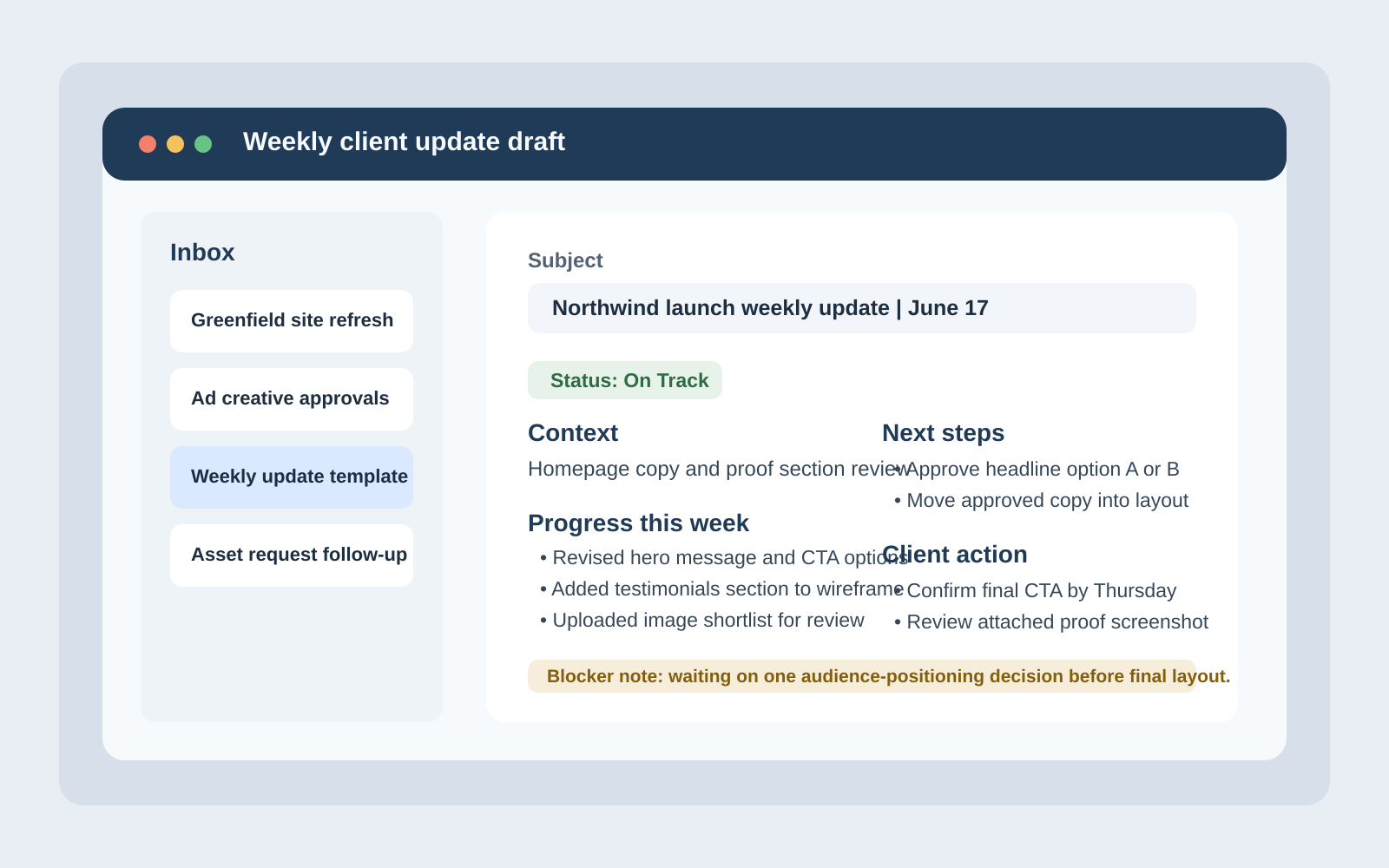
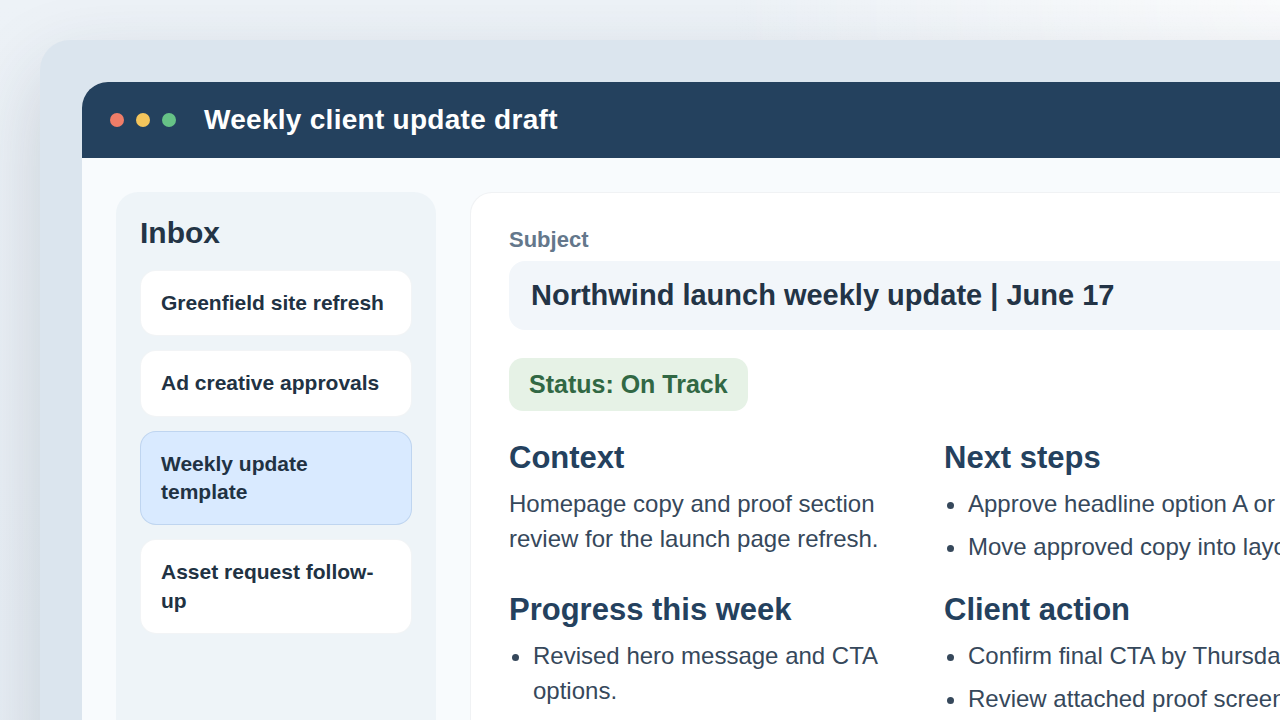 493:
493: